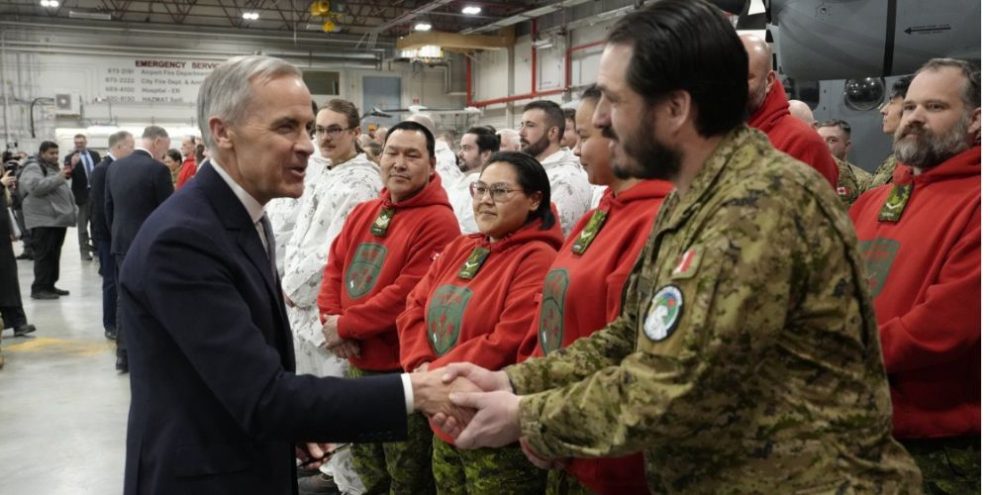
Prime Minister Mark Carney said Thursday the government is putting an additional $32 billion into military forward operating locations in Yellowknife, Inuvik and Iqaluit and Deployed Operating Base 5 Wing in Goose Bay, N.L.
The prime minister made the announcement in Yellowknife on Thursday before taking off for a planned visit to Norway.
"With this plan, we are taking control of our future," Carney said. "We will no longer rely on others to defend our Arctic security or to fuel our economy. We're taking full responsibility for defending our sovereignty."
The $32 billion is part of Canada’s 2022 commitment to Norad's modernization, which at the time included plans to spend $38.6 billion over 20 years. The Norad spending includes the purchase of two over-the-horizon radar modules.
A senior government official briefing reporters said the government envisions getting the work on the bases done over the next 10 years or so.
Asked by a reporter Thursday if there will be a bigger bill for Norad modernization, Carney said Thursday that the threat environment is "constantly evolving," which he said implicates Norad.
"We will be constantly updating what we need," Carney said. "Sometimes we won't need expensive systems that we thought we needed because things have moved in a different direction, sometimes we'll need new systems, and we'll be updating those through updates to the defence strategy, but also through the budget process."
The new funding for base infrastructure includes plans to improve airfields and to build or repurpose hangars, ammunition compounds, fuel facilities and housing.
The official said all of these bases will be able to accommodate fighter jets — including F-35s.
The announcement includes $2.67 billion for four new remote operating hubs across the North to assist with rapid deployment.
The two main Northern Operation Support Hubs will be built in Whitehorse and Resolute, Nvt. The government says they will include airstrips, logistics facilities and critical supplies to enable faster military responses.
They will complement three previously announced hubs in Yellowknife, Iqaluit and Inuvik.
The two smaller facilities, referred to as Northern Operation Support Nodes, will be built in Cambridge Bay and Rankin Inlet, Nvt. The government says they will be able to provide the same response services as the larger hubs, but at a smaller scale.
The government is also putting a combined $294 million into revitalization efforts at the Rankin Inlet and Inuvik airports.
"These defence investments will strengthen our military's presence and at the same time, what they will require is new energy infrastructure, new broadband and new telecommunication services, new wastewater services," the prime minister said. "What that means is as we build these military operations, we can transform and benefit the surrounding communities."
Carney is also referring four northern “national interest” projects to the federal major projects office for accelerated approval.
Barrie's News Delivered To Your Inbox
By submitting this form, you are consenting to receive marketing emails from: Central Ontario Broadcasting, 431 Huronia Rd, Barrie, Ontario, CA, https://www.cobroadcasting.com. You can revoke your consent to receive emails at any time by using the SafeUnsubscribe® link, found at the bottom of every email. Emails are serviced by Constant Contact
They include the Mackenzie Valley Highway, which will connect Yellowknife and Inuvik. This road will be about 1,200 kilometres long and is expected to serve as an all-season economic corridor in the region.
Carney said Thursday that construction on the Mackenzie Valley Highway will start in the summer.
The prime minister is expected to forward three other projects — the Grays Bay Road, the Arctic Economic and Security Corridor, and the Taltson Hydro Expansion Project — to the major projects office.
The Grays Bay Road is expected to extend from the Nunavut boundary with the Northwest Territories to a deepwater port in Gray’s Bay on the Arctic Ocean.
The Arctic Economic and Security Corridor would be a 400-kilometre road through the Slave Geological Province to the Nunavut boundary, where it would link with the Grays Bay Road. A specific route for this road is still being determined.
The Northwest Territories government is proposing the Taltson Hydro Expansion Project, a 60-megawatt project that would double the territory’s hydroelectricity capacity.
The senior official said building up power projects is key to supporting expanded CAF operations.
Yukon Premier Currie Dixon said in a statement Thursday that he was "surprised and disappointed" to see that none of the money will flow to the Yukon.
“The Yukon is home to the largest city in the North and more than a third of the total population of the North," said Dixon. "Despite this the federal government seems to have completely overlooked the Yukon."
The premier added that he is pleased to see the "significant investment" in the neighbouring territories.
"A plan to defend and transform Canada’s Northern and Arctic region cannot neglect one third of the North," he said. "I call on the Government of Canada to recognize the Yukon’s strategic potential in this plan and to provide financial support to address our urgent energy, road and health care infrastructure needs vital to the sovereignty of our territory and of Canada."
Northwest Territories Premier R.J. Simpson said Carney’s announcement marks "an important step forward" for the Northwest Territories and for Canada’s Arctic.
"The Arctic is central to Canada’s future," he said. "Strengthening infrastructure, transportation and energy systems in the North helps ensure that Canada can fully exercise its sovereignty while unlocking opportunities for people who live here.
"A stronger North means a stronger Canada, and we look forward to working with our federal and Indigenous partners to turn this vision into reality."
This report by The Canadian Press was first published March 12, 2026.