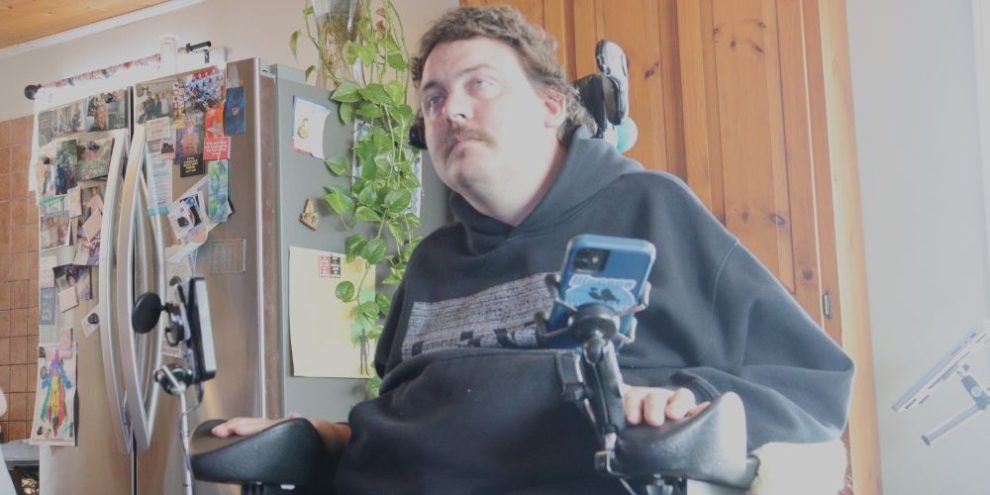
Years after a diving accident left him paralyzed, Jesse Spina is learning to navigate the world in a new way.
Not with his hands, but with his thoughts.
As part of a Neuralink clinical trial, he’s the first person from Ontario testing a brain implant designed to restore technological independence.
Only one other person, a man from Alberta, has the same technology implanted, holding the esteem of being the first trial subject outside the United States.
The life-altering technology was introduced to the Elmvale man after a "terrible decision" in 2020 that left him paralyzed below the neck.
"I was out with my friends having a couple of drinks and it came to the point where we all gathered to the creek," he recalled in an interview with Barrie360.
"It wasn't the first time I dove in there, but the second time got me. From there, I was upside down—underwater, but fully conscious—and then I kind of drowned at that point. My friends were able to pull me out, resuscitate me, call an ambulance, and send me off on my way."
A 20-hour surgery later, doctors determined Spina would live quadriplegia. Despite an easy recovery, his mental pain was difficult to hurdle. Sadness and self pity were at an all-time high, but he says he was trying to be easy on himself.
For over five years, he was confined to a wheelchair, heavily reliant on aid from his parents or friends at the house. Even when it comes to the little things like itching the face or drinking. But the 35-year-old says conversation has made the biggest impact.
"Company's been the bright saving star of all this," he says. "Having somebody to talk to and relate... I wasn't that big into social things before, but now I'm a little bit more engaged."
A glimmer of hope came in March 2025, when Spina was contacted by representatives from Neuralink. They learned of his condition through Spina signing up for information about clinical trials, and followed up with a series of interviews giving him the gist of the project.
"I was really interested in it at the time," Spina recalls. "It sounded up my aisle and I jumped on it. From there, I learned about Neuralink and I backtracked."
Despite outside ethical concerns regarding the project and the results reported from previous patients, Spina bought in, in full agreement with what the goal was.
However, it was hard to get his parents on board.
"They think the worst for their son, like what could happen against me and all that," Spina said. "It took a little bit more coaxing onto it, but when we got to about the day of or the day before, they were more excited for it than not."
Barrie's News Delivered To Your Inbox
By submitting this form, you are consenting to receive marketing emails from: Central Ontario Broadcasting, 431 Huronia Rd, Barrie, Ontario, CA, https://www.cobroadcasting.com. You can revoke your consent to receive emails at any time by using the SafeUnsubscribe® link, found at the bottom of every email. Emails are serviced by Constant Contact
On Sept. 3, Spina had the experimental chip implanted into his brain by Dr. Andres Lozano at Toronto Western Hospital—a four to five hour procedure.
Electrodes were implanted into the motor area of each patient’s brain to harness neuron signals and translate those signals into actions on an external device, skipping over the need to physically move, Lozano explained.
Lozano has said patients could move a computer cursor almost immediately after the surgery, and were able to leave the hospital the next day.
“The first patient was able to control a cursor by just thinking within minutes. It is extremely rapid. The signals are decoded and the artificial intelligence reads the signals and then translates them into movement on the cursor,” he said to the Canadian Press.
“They just think about it and it happens.”
Spina has also said the results felt immediate.
"The more you do (the exercises) that the smoother the cursor gets," he says. "This takes a total of maybe 10 minutes, 15 minutes tops, and then you have full control of the mouse cursor, extremely well. At first it felt like I was using a mouse again, which was really remarkable."
Roughly three times per week, he consults virtually with Neuralink officials who measure neuron signals, and how they're interacting with the technology.
Despite all the benefits, battery capacity remains the biggest limitation.
He explains charging like wearing a hat, with the device earning more life similar to how a wireless phone charger works.
"If I don't use it for a couple days... I can't control it so well. So, I need somebody to help guide me," Spina explains. "That's also why I have it on an Apple is because it's got voice controls and commands to it too, so in case I get into those situations, I can still get myself out of them."
Much of the actions he can do with his mind include gaming, although he says there are still some video games, like in the Call of Duty franchise, that are still far too fast-paced to succeed with. He has also learned to type on a keyboard.
Brain-computer interface (BCI) devices are not exclusive to Neuralink, and other companies like New-York based Synchron, are conducting their own clinical trials.
Spina says his experience with Neuralink has changed his tune on Elon Musk, and he considers him the most misunderstood part of the project.
"A lot of people hate that guy but like this company that he's helped forge is doing some of the craziest things in the world."
The company is also aiming to restore eyesight for the blind with its "Blindsight" project using Neuralink technology, with a trial that has begun in Asia. Additionally, it has goals to bring back hearing for the deaf.
Since Spina recieved the chip, the trial has expanded to the United Kingdom.
Both Canadian patients will be monitored for at least a year, with the clinical research team since being permitted to enrol another four patients in the country who have either been paralyzed by a spinal cord injury or who have Amyotrophic Lateral Sclerosis (ALS).
The clinical trial team will be evaluating if the technology is safe and if it adds value to the patient’s quality of life. Side effects they will be looking out for could include seizures, infections or strokes.
An estimated 85,556 people with spinal cord injury in Canada, according to Spinal Cord Injury B.C. Around 44,000 of those were as a result of traumatic injury.
Spina has said that he would recommend someone opt for using Neuralink if, for example, they were in his situation.
"You've got nothing to lose, and everything to gain."
—with files from The Canadian Press