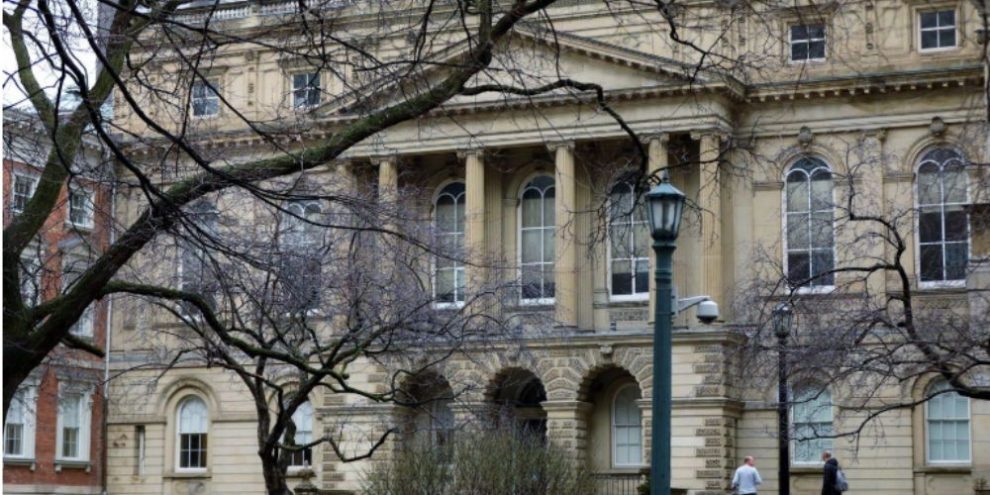
Ontario's top court has overturned a lower court decision that had struck down as unconstitutional parts of an agriculture law that made it illegal to get a job on a farm under false pretences to expose conditions inside.
In 2020, Ontario enacted the Security from Trespass and Protecting Food Safety Act, saying it would protect farm operations from threats posed by trespassers, including those who pose as workers but are covertly documenting animal treatment or other practices.
Advocacy group Animal Justice, along with an activist and a journalist, launched a Charter challenge in 2021, arguing that the law's actual purpose was to at least in part prevent documentation of animal mistreatment, claiming it was a direct attack on the Charter-protected freedom of expression.
Superior Court Justice Markus Koehnen struck down parts of the bill in 2024, and the province moved to appeal the decision, arguing the judge erred by concluding the law limited Charter-protected expression by activists, journalists and whistleblowers.
The Ontario Court of Appeal says in its decision that although the production of exposes about farm animal treatment is "high value expression," there's a "minimal degree of impairment" compared with the law's benefits.
Animal Justice says in a press release that it will be reviewing the decision and considering all available options, including seeking leave to appeal to the Supreme Court.
“Undercover exposes are vital to exposing illegal animal abuse and suffering caused by standard industry practices, and we plan to continue fighting to protect this fundamentally important form of expression," said Kaitlyn Mitchell, Animal Justice's director of legal advocacy.
Alexandra Wilkes, a spokesperson for the attorney general, said the ministry has no further comment as the case is within the appeal period.
The law passed by Premier Doug Ford's government requires consent from the owner to be on a property where animals are kept, raised or slaughtered. That consent vanished under the law if someone lied to get on the property.
The province said the point of the act was to protect farmers and their animals, strengthen biosecurity and prevent economic harm. It was responding to demands from the agricultural industry and about 120 municipal resolutions calling on the government to do more to control trespassing.
Government lawyers had argued in their appeal that nothing in the legislation limits anyone from publishing footage obtained by way of an undercover operation.
The Appeal Court said the respondents had claimed access to the property of others "in circumstances where others are not willing to give it to them." It noted the effect of the law and its exceptions for journalists and whistleblowers does not "substantially interfere" with the respondents' intended expression.
"There is no entitlement to a legal framework that permits one to trespass on terms one finds acceptable," the decision said.
This report by The Canadian Press was first published June 3, 2026.