
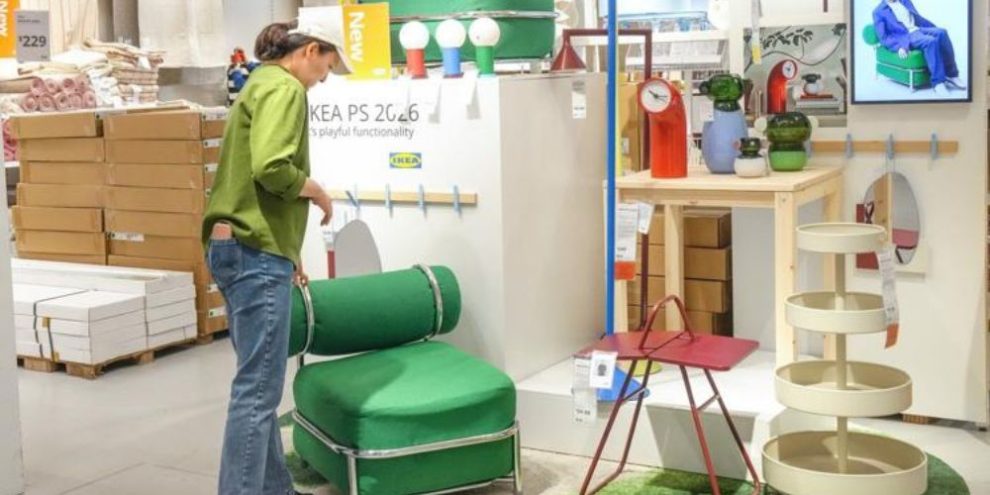
When Ikea opens its latest location at a London, Ont., mall this fall, shoppers will find their visits are far from the labyrinthine experience most have come to expect from the Swedish furniture giant.
The customers most impervious to browsing will make it through the shop in a matter of minutes and even those prone to spur-of-the-moment purchases likely won't have an hours-long ordeal.
That's because most Ikeas are at least 300,000 square feet — the equivalent of about six football fields — and typically feature 10,000 products. The one moving into the former Hudson's Bay at White Oaks Mall will be just 43,000 square feet and sell only 2,700 items.
"What you're seeing with what will open in London is an evolution of the small store format," said area manager Janet McGowan on a recent morning at a 65,000 sq. ft. Ikea in downtown Toronto.
Barrie's News Delivered To Your Inbox
By submitting this form, you are consenting to receive marketing emails from: Central Ontario Broadcasting, 431 Huronia Rd, Barrie, Ontario, CA, https://www.cobroadcasting.com. You can revoke your consent to receive emails at any time by using the SafeUnsubscribe® link, found at the bottom of every email. Emails are serviced by Constant Contact
The location she was sitting in and its forthcoming sibling are just the latest examples of a retailer thinking big by going small.
Uniqlo, No Frills, Best Buy, Sleep Country and Sephora have all opened small format stores in Canada in recent years. Their hope is that shrinking some of their locations will extend their reach into lucrative markets, where space is often at a premium but the consumer will to spend is strong.
As she cozied into a faux living room, McGowan argued small stores are a win-win. They let customers explore and get inspiration but also shave down the time it takes to open a new Ikea by 25 per cent and are a less costly investment.
"It makes more of a realistic model for us to be able to open many of these around the world," she said.
Others appear to have the same idea. Best Buy and Bell Canada teamed up in 2024 to launch 167 small format stores.
One of them is in Union Station in the heart of downtown Toronto. It's around the corner from a pared back Uniqlo that moved in when a petite Decathlon moved out.
It's no coincidence so many retailers are targeting the busy transit hub near several arenas and the Financial District, where there's no vacant land and seldom a sprawling space to rent.
"Often, you're not testing if your brand has relevance. You're looking at where else could I go with the brand that I haven't been able to go because of the space constraints," said Elisha Ballantyne, a Toronto-based retail consultant who helped Target launch its petite, urban stores in the U.S.
More often than not, the answer is busy city centres.
There, companies can cater to time-pressed workers on lunch breaks, nearby university and college students and urbanites who can't or won't make the trek to suburbia, where companies often find the real estate they need to run full-scale locations.
"If you think about people living in condos, people living in urban centres, do they have cars? A lot of them don't, so they're not travelling to the suburbs to go to a store," Ballantyne said.
But the strategy does have trade-offs.
Brands can't fit their whole inventory into a more compact space, making the small stores less likely to be a one-stop shop.
When Loblaw Cos. Ltd. launched its small format No Frills stores in 2024, it cut down on product variety. Rather than 10 types of spaghetti, an executive said at the time that customers would be more likely to see five.
At Ikea, the focus is on products that make the most sense for the community.
At the downtown Toronto store, that means slender furniture that can fit into shoebox-esque condos, artificial grass and wooden deck tiles to zhuzh up little balconies and the viral inflatable PS chair, which needs just a hearty set of lungs or a bicycle pump to assemble rather than a garage full of tools. Whatever isn't available in the store, shoppers are told to look for online.
To make best use of the space, Ikea has also cut the kids play centre and shrunk the kitchen planning and checkout areas.
For the most part, shoppers have adapted well and where they haven't, Ikea made tweaks.
Take its plant department, for example. When the small store in downtown Toronto opened in 2022, succulents and other greenery weren't on offer.
"But what we have come to realize is that when you live in the city, there's a lot of concrete around us," McGowan said.
"Having live plants and bringing nature inside is so important to the people that live here that ... we decided we would try it and see how it does. Now, we have to get two deliveries a week."
The fixes aren't always so easy.
Ikea dumped the small format store it opened at the Scarborough Town Centre shopping mall in Toronto earlier this year, less than three years after it was launched.
It attributed the decision to shifting consumer behaviour toward online shopping and the store's limited range of products, which it said resulted in a weaker-than-expected performance.
"That format actually wasn't really meeting what the consumer was looking for and to be perfectly frank, if you want the full-store experience, you can go to North York," McGowan said, referencing another Ikea that was a 15-minute drive away.
Some small stores run by Target, Macy's and Walmart have all suffered a similar fate, but that hasn't stopped the trend from growing.
Last week, cosmetics giant Sephora opened its first small format store in Canada. To fit into the 2,000 sq. ft. location in Kitsilano, B.C., it has stripped out the snaking checkout line and edited how many items it offers from each brand.
In Toronto, food emporium Eataly is also hanging onto the little store it opened in the Distillery District in 2025, which was initially a pop-up.
McGowan suspects they won't be the last brand to give the small store trend a try, because retailers have to keep up with customers if they want to survive.
"If you don't evolve and transform in ways that stay current and with the demands of the consumer, you're not going to be able to have the longevity," she said.
This report by The Canadian Press was first published June 14, 2026.