Experts are warning that U.S. President Donald Trump's threatened new set of tariffs could drive wedges between Canadian provinces, allowing the U.S. to exploit regional grievances to force trade concessions.
The tariffs would have particularly heavy impacts on industries concentrated in B.C. and in small towns across Quebec.
"There's an awareness that Canada can be a punching bag for the United States, but different parts of the country can be treated differently," said University of British Columbia political scientist Stewart Prest.
"At the extreme, that does lend itself to a divide-and-conquer strategy, which Canadians really have to be aware of."
A new round of 50 per cent American tariffs on a range of Canadian goods is set to take effect on Aug. 19.
Unlike most of Trump’s other tariffs, these would have no exemptions for goods that comply with CUSMA.
University of Calgary economics professor Trevor Tombe has reported that the threatened tariffs would hit B.C. the hardest while largely sparing the Prairie provinces.
Tombe found 13.7 per cent of B.C. exports to the U.S. would be hit by the new tariffs, while roughly one per cent of exports from Saskatchewan and Alberta would be affected. Quebec would see 10.8 per cent of its exports to the U.S. affected, while nine per cent of Ontario's exports would be exposed to the tariffs.
In an analysis published on July 30, the Canada West Foundation said this uneven application of the tariffs could make it harder for Canada to mount a coherent response to U.S. trade aggression.
"A two-speed Western Canada, where one province absorbs a direct hit to its manufacturing base while its neighbours are shielded by resource exemptions, complicates any unified Team Canada response," the think tank argues. "It deserves more national attention than it’s getting."
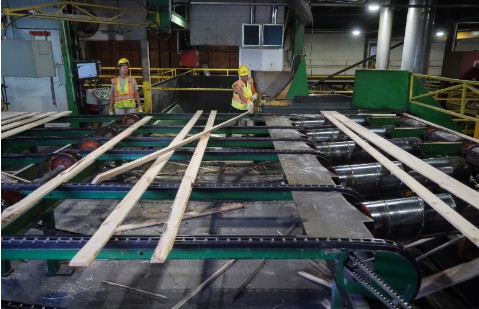
The Canada West Foundation noted that B.C.'s forestry sector would be hit hard, as would sectors that had been protected by CUSMA exemptions.
"This is the highest concentration of any province, and it’s driven largely by high-value electrical components and boards, along with wood and paper products," the analysis found.
Prest said B.C. is likely exposed because of years of efforts to boost trade between the province and America's West Coast in sectors like transportation and mining. Trade was already tightly integrated because Vancouver's outer suburbs come close to the U.S. border, he said.
"That leaves us vulnerable in a way that is similar to, but distinct from, the rest of the country," he said.
The Canada West Foundation noted Alberta and Saskatchewan are largely untouched because the U.S. is not applying tariffs to energy and potash exports. The premiers of both provinces have rejected using energy as a bargaining chip and have broken with their peers by restoring consumer sales of American alcohol products. The remaining booze bans continue to infuriate U.S. officials.
Prest said the alcohol bans are among the policies the Trump administration could target as it goes after specific regions.
"Trade in Canada is, and has long been, strongly north-south. In many ways, the links between provinces and the United States are more central to trading patterns than across the country itself," he said.
"To the extent that Canada is knit together as a country, it has been a political act to bring the provinces together."
Prest cited comments U.S. Treasury Secretary Scott Bessent made in January about Alberta's separatism movement. Bessent said the province is a "natural partner for the U.S." full of "very independent people."
Quebec appointed former senior diplomat Louise Blais as official envoy for the review of the CUSMA. She said the tariffs could be "absolutely catastrophic" for entire communities in the province.
Blais said American trade officials seem to have targeted companies that are the lifeblood of small towns that rely on American clients — particularly companies that make products Americans can source from other countries.
"It targets a certain size of company, major employers in small towns across Quebec, in the textile industry, cement and wood flooring and furniture," Blais told the Canadian International Council podcast Red Passport in an episode that aired Aug. 1.
"Some of them are already thinking of closing down because some of their orders have gone down. They'll close down for a couple of weeks in the month of August."
Blais argued media coverage hasn't fully conveyed the severity of the looming tariffs. While RBC Economics says tariffs will apply to just 5 per cent of the value of Canadian exports to the U.S., Blais called that statistic "really misleading."
"Because if you take away all the commodities, potash, oil, all the big stuff we send to the United States, it's actually a much bigger percentage of value-added manufacturing goods that we send," she said.
Blais said hundreds of companies are telling the Quebec government they can't survive long enough to diversify away from the U.S. market if the tariffs take effect.
"I don't think inaction or waiting will help. Those companies will be gone in a month or two," she said.
Carlo Dade, head of the University of Calgary’s New North America Initiative, warned in a commentary that the Aug. 19 tariffs allow the U.S. to deploy "a divide-and-conquer strategy" against Canada.
He noted that, unlike previous rounds of tariffs, the Aug. 19 tariffs are based on rules that can target certain products coming from one region of Canada.
"Section 338 expressly authorizes the president to suspend, revoke, supplement or amend any proclamation," he wrote.
"The obvious next step is a carve-out," he added, suggesting the Americans might let beer from Alberta and Saskatchewan enter tariff-free but not wines from Nova Scotia.
"The possibilities for mischief for personal or economic reasons are endless," he added.
He said Ottawa should be making Canadians aware that Washington likely will attempt regional coercion.
"The potential for mischief is not only economic. A carve-out that rewards one province and tempts the next is also designed to work public opinion — to make each province’s electorate weigh a separate path," he wrote.
Already, he noted, the Trump administration has been able to target industries, such as Ontario's auto sector, in ways that have a disproportionate impact on specific provinces.
Prest added that Canada could learn from Taiwan, which sits next to a powerful country that has used economic and political coercion against it. Taiwan years ago chose to specialize in semiconductor manufacturing — an industry that allowed it to establish strong trade ties beyond China.
"You can never escape dependence but you can find options and you can create alternatives," said Prest, whose teaching focuses on democratic institutions and international relations.
Prest said Taiwan is also a cautionary tale because the country's politics has been polarized over debates about its relationship with China. He said Canada could also face deep divisions between those who want to distance themselves from the U.S. and those who seek stronger ties.
"Taiwan has achieved a greater clarity in recent years because China has leaned on it more, so that has helped resolve that question. But there is a real divide, and we saw it lead to more polarized politics, a greater willingness to essentially do whatever is necessary to win an election," he said.
This report by The Canadian Press was first published Aug. 13, 2026.