
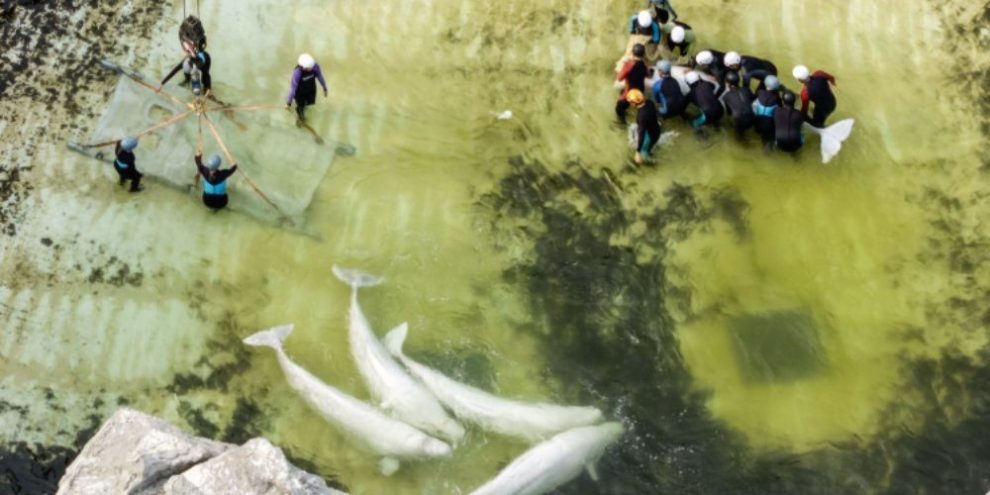
A third beluga that was a part of a massive move of whales from Marineland has died.
Jelly Bean, 19, died "suddenly and unexpectedly" on Friday, said Oceanografic Valencia.
The Spanish aquarium took in Jelly Bean and another beluga named Cleopatra in late August from the shuttered theme park in Niagara Falls, Ont., along with four bottlenose dolphins.
"In recent days, Jelly Bean had experienced feeding difficulties, prompting the veterinary team to intensify her monitoring," Oceanografic said in a statement.
"During this period, she showed signs of improvement and remained responsive to her caregivers, while continuing to receive around-the-clock monitoring."
Two Marineland belugas, Rain and Peekachu, and a resident beluga, Beethoven, at Chicago's Shedd Aquarium died within weeks of their move. The aquarium's investigation remains ongoing.
Nineteen belugas and Marineland's lone killer whale, Kiska, died at the park between 2019 and 2025.
The park had the largest collection of captive beluga whales in the world with 30. Former owner Marie Holer put the park up for sale in 2024 before closing for good after that summer. She died days after the closure after taking over the helm from John Holer, who founded the park in 1961 and died in 2018.
Sources say the park has been tentatively sold on the condition all the animals are gone before closing. Several hundred deer remain at the park.
Marineland and Oceanografic moved the two belugas along with four dolphins to Spain in a 20-hour odyssey on Aug. 27.
"At this time, it is not possible to determine the cause of death," Oceanografic said.
"Oceanografic’s veterinarians will conduct a necropsy together with the pathology team at CEU Cardenal Herrera University to try to determine the factors that may have contributed to her death."
Marineland has said its whales were healthy at the time they left the park. Fisheries Minister Joanne Thompson also cleared the whales and dolphins to move.
Marineland moved its whales and dolphins to five parks in the course of six weeks: SeaWorld locations in San Diego and San Antonio, the Georgia Aquarium in Atlanta, Shedd Aquarium in Chicago and Oceanografic in Valencia.
"We were deeply saddened to learn of the passing of Jelly Bean," Marineland said in a statement.
"Our thoughts are with the people who cared for her – the staff and caretakers who knew her daily, and everyone who followed her story."
In 2019, the federal government banned whale and dolphin captivity, but grandfathered in Marineland's animals. It also forbade breeding, which forced Marineland to separate its males and females. The law also banned performances.
The park blames some of its deaths, in part, on those changes.
That was the beginning of the end for Marineland.
Last year, Marineland had a deal to sell all its whales and dolphins to Chimelong Ocean Kingdom, an aquarium in China with a Guinness Book of World Records for the world's largest aquarium. It was the only place in the world Marineland could find that would take them all.
But Thompson nixed the deal, saying it wasn't in the best interest of the whales because they would be subject to different laws, including breeding and performing tricks.
In response, Marineland made international headlines when it said it was running out of money and needed an injection of federal funds, otherwise it would euthanize all its whales.
That threat of euthanasia remained on the table unless it could get the whales out.
It turned to a consortium of aquariums from the United States and Spain for help. Thompson eventually approved that move, despite the fact the whales and dolphins ended up in spots where breeding and performances were allowed.
The last captive whale in Canada, Tofino, left Marineland's waters on Aug. 31.
This report by The Canadian Press was first published Sept. 18, 2026.