
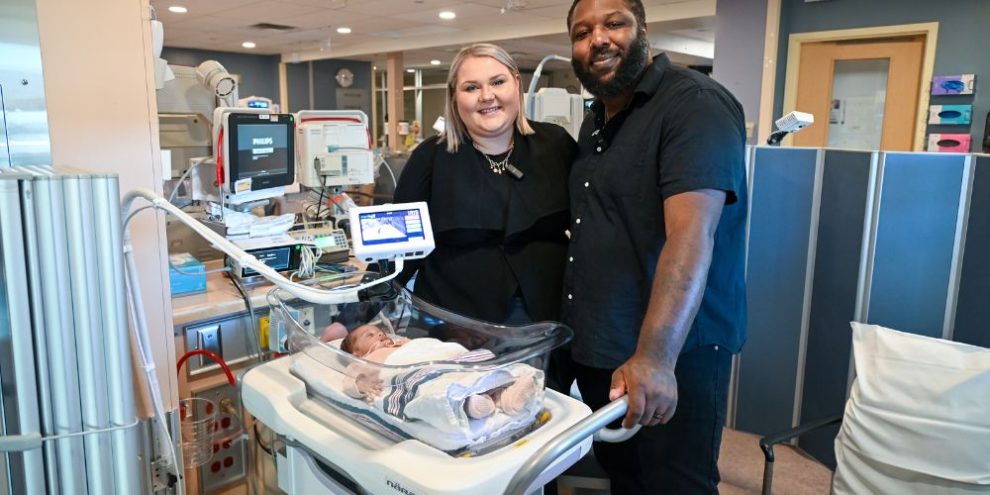
Royal Victoria Regional Health Centre (RVH) has become the first hospital in Canada to introduce technology that allows families to securely check in on babies receiving care in the Neonatal Intensive Care Unit (NICU) from anywhere, at any time.
The AngelEye CameraSystem provides parents and loved ones with a secure livestream of their newborn through a phone, tablet, or computer, helping families stay connected when they cannot be at the bedside.
The technology is designed to address a common challenge for families with babies in the NICU. Whether recovering from childbirth, caring for other children, working, or dealing with transportation and financial barriers, many parents are unable to spend as much time with their newborn as they would like.
“What started as a way to support new parents and caregivers during a difficult period made us realize just how valuable that connection is, regardless of visitor restrictions,” said Natalie Sherrit, Manager of NICU and Paediatrics at RVH.
“They told us how meaningful it was to see their baby when they couldn’t be there. Now, bringing AngelEye to RVH builds on that experience by giving families and their support systems secure, reliable access to their newborn around the clock and helping them feel more involved and engaged in their baby’s care journey.”
The idea for the system traces back to the COVID-19 pandemic, when visiting restrictions forced staff to find new ways to help parents remain connected to their babies through video technology. Hospital officials say the positive response from families highlighted the importance of maintaining that connection, even after restrictions were lifted.
AngelEye is also intended to support breastfeeding, maternal well-being, and parent-infant bonding during a critical period in a baby's development. By allowing families to participate more fully in a newborn's care journey, RVH hopes to reduce stress and anxiety while strengthening family connections.
RVH's NICU admits nearly 400 newborns each year, caring for some of the region's smallest and most vulnerable patients.
Among the first to experience the new system were first-time parents Brieanna and Rainier Croft after their daughter, Soleil, arrived unexpectedly at 33 weeks and one day.
“It’s so hard being separated from your baby,” said Brieanna. “Being able to see Soleil and know she was okay and receiving the best care possible was truly amazing. As first-time parents, it helped lessen so much of the anxiety that comes with having your baby in the NICU.”
Rainier said the technology provides reassurance not only for parents, but for extended family members as well.
“There’s a sense of closeness that comes from being able to pull up your phone and see your baby whenever you need to,” he said. “It’s incredible for parents, but also for grandparents and family members who may not be able to make the trip to the hospital. It helps everyone feel connected and involved during a very important time.”
While RVH says its NICU operates in a space that is constrained and in need of future expansion, staff continue to pursue innovative solutions aimed at improving the patient and family experience.
“Our team is incredibly committed to making every family’s experience as positive and supportive as possible,” said Sherrit. “While we’re mindful of the great need for expansion in our small and aging space, that has never stopped our staff from finding new ways to innovate, improve care and create exceptional experiences for families when they need us most.”
Hospital officials say the launch of AngelEye reflects RVH's ongoing commitment to enhancing care and strengthening connections for patients, families, and caregivers during some of life's most challenging moments.