Updated October 1, 2026 @ 1:58pm
A pipeline to haul Alberta oil to tankers on the B.C. coast took a big step forward Thursday.
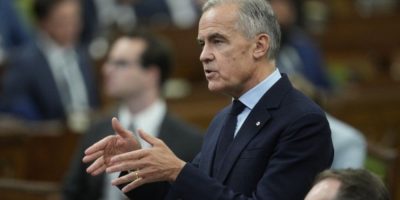
Prime Minster Mark Carney, with Alberta Premier Danielle Smith at his side, announced the line – to be known as Pacific Link — is the first project to receive national interest designation under the Building Canada Act.
The designation doesn't mean the line is a done deal, but it streamlines and simplifies rules, timelines and oversight to help make it a reality.
The goal is to get consultations, environmental safeguards, financing and Indigenous partnerships completed by Sept. 1, 2027, to clear the way for construction to begin.
"This is an important day for Alberta and for Canada," Carney announced in the oilsands hub of Fort McMurray.
“Canada is working.”
Barrie's News Delivered To Your Inbox
By submitting this form, you are consenting to receive marketing emails from: Central Ontario Broadcasting, 431 Huronia Rd, Barrie, Ontario, CA, https://www.cobroadcasting.com. You can revoke your consent to receive emails at any time by using the SafeUnsubscribe® link, found at the bottom of every email. Emails are serviced by Constant Contact
The project, estimated at between $35 billion and $44 billion, is to be split among Trans Mountain Corp., which is a federal Crown corporation, and the Alberta government. Indigenous communities will be offered a minimum of 10 per cent ownership interest, financed through federal and province loan programs.
Pembina Pipeline Corporation is offering its expertise to project development as a private sector investor.
The roughly 1,250-kilometre pipeline would carry upwards of one million barrels of crude oil per day from Bruderheim, Alta., to a port near Delta, B.C., for shipment to international markets.
"A pipeline to the West Coast is part of our mission to transform our economy to double our non-U.S. exports over the next decade," Carney said. The goal is "to unlock the full potential of Canada as a global energy superpower."
"Today, 90 per cent of Alberta's oil goes to the U.S.," he said.
"Pacific Link will materially reduce that dependence by allowing us to export an additional one million barrels a day to growing markets in Asia.
The line has also been cited by both Ottawa and Alberta as a symbol of the power of pan-Canadian co-operation, as the province heads toward a referendum in 18 days on whether it's time to quit Canada.
The symbolism was written on the lectern from which Carney and Smith spoke: Canada Strong for All.
Smith said the pipeline means the days of federal-provincial head-butting over Alberta developing its resources are over.
"Today, we're turning the page," Smith said.
The Building Canada Act, passed more than a year ago, gives Ottawa the power to issue special conditions for projects covering a dozen federal laws in order to help them proceed.
It has been a yearlong process that began last November, when Ottawa and Alberta signed an energy pact committing the federal government to declare a pipeline from Alberta to the West Coast a project in the national interest.
Industry watchers say it’s a fragile process, dependent on chicken-and-egg calculations: oilsands production won’t ramp up unless there’s a new pipeline, but no one wants to build a new pipeline unless they’re assured of ramped-up oilsands production.
Lance Mortlock, managing partner at EY Canada, said that in recent years producers have shied away from big-ticket investments in part because of shortage of pipeline capacity.
“My sense is they’ve been waiting to see if some of the conditions start to change,” Mortlock said.
“And now the work is beginning at some of these oilsands companies to say, ‘Well, what does that look like? What kind of assets would we develop? How big would we develop them? What's the sequencing of those assets?’”
Industry has welcomed Ottawa’s moves to simplify the regulatory process, roll back Trudeau-era environmental policies and beef up tax incentives for new investments. Smaller scale, shorter-term pipeline expansion projects to the U.S. and West Coast are in the works.
Thursday's declaration is the second major energy announcement this week. On Tuesday, the partners behind the LNG Canada natural gas export facility in Kitimat, B.C., gave the green light to an expansion that would double capacity.
The Alberta pipeline announcement is also about politics.
On Oct. 19, Albertans go to the polls to vote on whether the province should stay in Confederation or hold a second, binding referendum on beginning the process to separate.
Smith has held up the new pipeline as a tangible example of how Canada can work and why Albertans need to vote with her to stay.
Recent public surveys indicate strong majority to keep Alberta in Canada.
Smith has championed staying, but critics say it’s not about that. They say her referendum is a duplicitous double game, designed to stay onside with mainstream Albertans while placating rebellious separatists in her governing United Conservative Party.
The premier spoke about her commitment at the lectern Thursday, saying again she's voting for Alberta to stay in Canada.
“And I've been doing as many speeches and public appearances and coffee parties as I can to convince more and more Albertans to do the same.
Smith said a recent poll suggests about 22 per cent want to separate. But that number is “still too high for my liking.”
This report by The Canadian Press was first published Oct. 1, 2026.
— With files from Nick Wells in Ottawa, Lauren Krugel and Dayne Patterson in Calgary and Daniel Johnson in Toronto