Updated December 1, 2025 @ 6:09pm
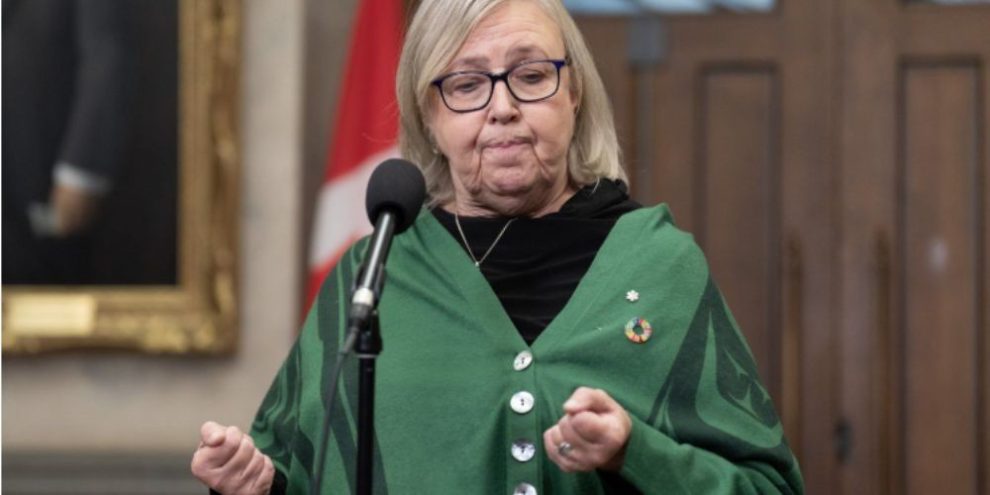
Green Party Leader Elizabeth May says supporting the Carney government on the budget vote is a "mistake" she won't make again.
May told The Canadian Press the memorandum of understanding Prime Minister Mark Carney signed with Alberta Premier Danielle Smith on energy — specifically the part that applies federal tax credits to enhanced oil recovery — amounted to a "significant betrayal and a reversal" which has her questioning the worth of Carney's word.
"I don't know if the prime minister lied but I think he needs to consider what his word means when his word was given," she said.
"He obviously thought getting a deal with Danielle Smith was more important than his word."
As The Canadian Press reported Friday, then-cabinet minister Steven Guilbeault was dispatched to win May's vote for the budget last month, having received assurances from Carney's office that tax credits for enhanced oil recovery would not be in the budget or added to it afterwards.
Enhanced oil recovery is a carbon storage technology that captures carbon dioxide from industrial emitters and injects it underground at oilfields. That increases pressure and pushes more oil out of the rock, while the carbon dioxide is trapped underground.
Environmentalists, including Guilbeault, see a tax credit for enhanced oil recovery as a direct subsidy for oil production.
The section of the budget addressing tax credits for carbon capture utilization and storage, often abbreviated as CCUS, said enhanced oil recovery would not be eligible for a federal subsidy. May had heard rumours that the government was going to reverse that decision.
It was one of the things keeping her from supporting the budget — until Guilbeault gave her his word that would not happen.
Barrie's News Delivered To Your Inbox
By submitting this form, you are consenting to receive marketing emails from: Central Ontario Broadcasting, 431 Huronia Rd, Barrie, Ontario, CA, https://www.cobroadcasting.com. You can revoke your consent to receive emails at any time by using the SafeUnsubscribe® link, found at the bottom of every email. Emails are serviced by Constant Contact
But the deal with Alberta — signed 10 days after May voted in favour of the federal budget — commits Canada to extending federal tax credits to encourage large-scale CCUS investments, including the Pathways Alliance project "and enhanced oil recovery in order to provide the certainty needed to attract large additional sources of domestic and foreign capital."
The reversal on the tax credit was also one of the reasons behind Guilbeault's decision to leave cabinet.
Appearing on the popular Radio-Canada Sunday talk show Tout Le Monde En Parle, Guilbeault said the Alberta deal was "the last straw."
Guilbeault said he's had to make compromises over his years in politics but he wouldn't have been able to defend this deal.
"In a country of 40 million people, you know you're going to lose (some battles). That's normal," Guilbeault said in French.
"This decision, it's a disagreement I have with the prime minister on how to approach the fight against climate change. But, if there were an election tomorrow morning, I would vote for Mark Carney."
May said she doesn't regret voting for the budget because she got Carney to affirm Canada's commitment to meeting its Paris agreement climate targets.
Her vote wasn't decisive since the NDP and Conservatives each had two abstentions, ensuring the budget would pass and staving off the possibility of a winter election.
"I don't regret doing what I thought was right. I remain convinced that what I did was principled and what I did was for the right reasons, and I haven't broken my word," May said.
"I kept my word and I voted for confidence in this government. I will not make that mistake again."
Asked Thursday why it was necessary to include tax credits for enhanced oil recovery in the budget, Energy and Natural Resources Minister Tim Hodgson said it was something that was "important to Alberta."
"Look, I think different people can have different perspectives. When you are injecting carbon permanently into the ground and permanently sequestering it, that is a good thing. I think there is a belief that it is a productive thing to do," Hodgson told The Canadian Press.
"I would also tell you that would generate one of the fastest and largest responses to use of Canadian steel, in terms of drill pipe, of any particular policy decision that could be made. And so that's something that was discussed."
Taking questions Monday from reporters at a luncheon hosted by the Canadian Association of Energy Contractors in Calgary, Smith said enhanced oil recovery was one of the first things she mentioned to Carney in their first meeting after his election win.
"I said, 'This is one of the irritations for Alberta. Can we find some compromise on this? Knowing that the bulk of the CO2 that's going to be captured is going to be stored?'" Smith said.
"And (Carney) was amenable to that."
This report by The Canadian Press was first published Dec. 1, 2025.
— With files from Mia Rabson in Ottawa, Lauren Krugel in Calgary and Coralie Laplante in Montreal.