Bruce MacLeod never thought he would forget his own birthday.
But a couple days after a heart valve replacement in February 2025, he did.
"It was strange. It was just out of reach, like, if I reached a little further, I could have pulled those memories back, but I was unsuccessful at the time," MacLeod, 65, said.
His partner, Harry Ennis, recalls coming into the hospital room one day to find MacLeod had ripped off his heart monitor, and his belongings were packed up to leave.
Ennis asked why. MacLeod replied he didn’t know.
“And then when I talked to a nurse, matter of fact, he said, ‘Oh, that's delirium, that's pretty normal,’” Ennis said.
Ennis said if he had known about his partner's potential risk of delirium beforehand, he could have tried to prevent it, “rather than, it's here. Now what do we do?”
“I think it would have made a huge difference.”
Research shows about one in four adults become delirious during a hospital admission. That’s about 500,000 Canadians a year.Age is a risk factor, as delirium presents in about half of hospitalized patients ages 65 and older.
Almost any medical condition can lead to delirium, an “acute brain failure” that causes a patient to suddenly be severely confused. They can hallucinate and be aggressive, punching a family member or spitting on a nurse, or they can be sleepy, lethargic and withdrawn.
Up to 40 per cent of cases can be prevented with proper sleep, hydration, nutrition and mobility, research shows. But delirium is often unrecognized, misdiagnosed as depression or dementia, or misattributed to aging. Recognition rates can be as low as 16 per cent.
A randomized control trial rolling out at 13 Ontario hospitals is aiming to reduce preventable cases by identifying patients who might get delirium with an artificial intelligence calculator that suggests who to prioritize.
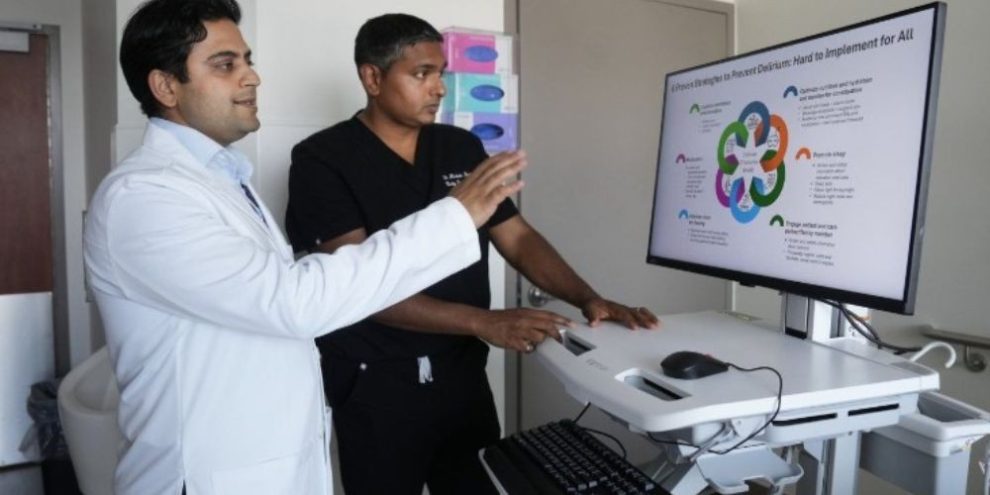
Between patients, Dr. Amol Verma rolls a computer into a hospital room on the general internal medicine ward at St Michael’s Hospital in Toronto to show how it works. It'll be used on real patients at the hospital starting in October as part of a one-year trial split into two groups — six other sites in the province are already using the platform.
Verma opens a web browser to a delirium risk prediction calculator and inputs a hypothetical 78-year-old woman’s information – her medical record number, hospital, age, lab test results and diagnoses.
A red message appears on the screen: “high risk.”
“This patient has an estimated greater than 50 per cent risk of developing delirium. If clinically appropriate, consider prioritizing them for delirium prevention bundle.”
The bundle includes assisting with meals to monitor nutrition, suggesting sips of water, keeping track of daily mobility, adjusting light to help with sleep, relaxation exercises and cognitive stimulation activities.
Dr. Jacques Lee, who is not involved in the trial but has researched delirium for 20 years, said a tool that helps health providers recognize it has a lot of potential.
"The very nature of delirium itself leads to difficulty recognizing it," Lee said, noting the range of presentations, which can fluctuate and even go away and come back.
But he said for the tool to actually improve outcomes, issues such as overcrowding and staff shortages that often push basic care to fall by the wayside also have to be fixed.
“We all know what we're supposed to do. What actually happens on the wards – that's where the rub is," said Lee, inaugural research chair of Schwartz Reisman Emergency Medicine Institute in geriatric emergency medicine.
The absence of this care can be deadly. Those with delirium are more than twice as likely to die in hospital or require a nursing home. It's also associated with worsening cognitive impairment and dementia. An Ottawa-based study in 2021 found a patient's hospital stay can increase by almost a week and cost an additional $6,000.
HOW IT STARTED
Verma became aware of delirium on a personal level almost 20 years ago when he noticed his grandmother was disoriented after surgery on a fractured leg.
“Seeing her be confused was just striking because she was someone who was very sharp mentally,” Verma said.
He recalls her thinking that she was preparing for a wedding, trying to write invitations from her hospital bed.
“Now practising as a clinician, we just see this entity so commonly and it's so clear how profound an effect it has on people and their families,” he said.
Verma was in medical school at the time. Years later when he became a staff physician, he got a call from former classmate Dr. Fahad Razak who was startled by the amount of health data that existed, and how little of it was being used to improve patient care.
Barrie's News Delivered To Your Inbox
By submitting this form, you are consenting to receive marketing emails from: Central Ontario Broadcasting, 431 Huronia Rd, Barrie, Ontario, CA, https://www.cobroadcasting.com. You can revoke your consent to receive emails at any time by using the SafeUnsubscribe® link, found at the bottom of every email. Emails are serviced by Constant Contact
Together, they began building a hospital data research network called GEMINI, short for General Medicine Inpatient Initiative, that now includes about 40 hospitals in Ontario, run out of St. Michael’s Hospital. They recently received $100 million from the federal government’s artificial intelligence strategy to nationally scale it.
The delirium risk calculator is one of their projects and began with a research study of nearly 4,000 admissions at six Toronto area hospitals.
Delirium is often underidentified and inconsistently documented in routine hospital data, Razak said. To address this, they manually reviewed each record in painstaking detail for 30 minutes to an hour to determine whether the patient had delirium.
Delirium was identified in just over six per cent of admissions in the routine hospital data compared to 25 per cent in the manual review. With the adapted data set, they trained machine learning models to identify delirium. The model captured about 75 per cent of cases, a subsequent study shows.
They also surveyed thousands of patients on their social and demographic backgrounds, also often absent from medical records, to test the algorithm for bias. Studies show patients with delirium who don’t speak English are much more likely to berestrained, Razak said, as an example.
The randomized clinical trial is now testing how the calculator works in a variety of busy hospital environments, from downtown teaching hospitals like Toronto Western, to smaller community settings like Niagara Health Marotta Family Hospital.
“An important part of the trial is recognizing that for a technology like this, it can't just be a predictor that a clinician uses. You have to think about the system, the entire ecosystem of who's going to receive that information and what patients and families are going to do with it,” Razak said.
This report by The Canadian Press was first published Aug. 4, 2026.
Canadian Press health coverage receives support through a partnership with the Canadian Medical Association. CP is solely responsible for this content.