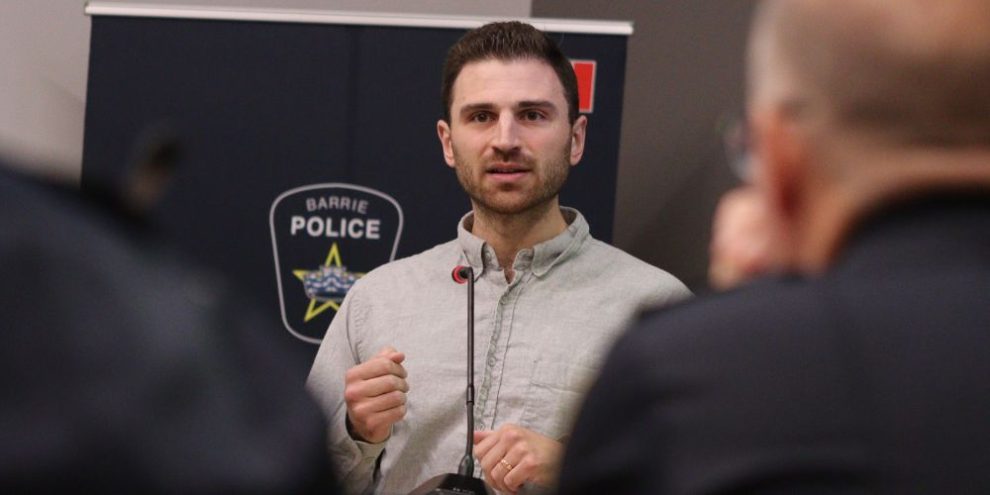
Patients may be avoiding addiction treatment in downtown Barrie due to open drug use and loitering outside a methadone clinic, a local physician told the Barrie Police Service Board Thursday.
Dr. Josh Fletcher, founder and medical director of Arrow Medical, said in a deputation that groups regularly congregate outside the clinic's location, creating concerns for patients and staff, and discouraging some people from accessing treatment for opioid use disorder.
His clinic is one of three such methadone clinics in the area of Dunlop Street West and Toronto Street, with the other two either being set back on private property or on the second storey of a building.
Arrow Medical is found within a Pharmasave location at street level.
"At least 50 per cent of these individuals (loitering) are not patients of our clinic, and I have absolutely no idea who they are," Fletcher told board members.
His appearance before the board comes after a conversation he says he had with Barrie Mayor Alex Nuttall last week, who recommended he bring his issues to the board, which had discussed the service's downtown enforcement initiative in its May meeting.
Fletcher says he and his staff are constantly getting referrals from the County of Simcoe's HART Hub program with the vast majority of patients the clinic sees being unhoused while struggling with fentanyl abuse.
It has already hired private security, which has been helpful, but ultimately displaces individuals to nearby areas. Other times, when police get involved, the loiterers move for half an hour or so before returning.
"I have taken steps [toward] banning individuals, and I do that frequently and feel like we need to," Fletcher said. "I would imagine the pharmacy does the same thing."
Barrie Mayor Alex Nuttall questioned if there's specific legislation that guarantees access to medical services and protects entrances to medical services, especially coming off of public property.
"We're struggling with what the law allows us to do and doesn't allow us to do," he said. "I've never thought of this from a medical practice perspective and access to such services."
Barrie Police Chief Rich Johnston said the situation downtown is complex, noting officers must balance public safety concerns with the need to ensure vulnerable people continue accessing medical treatment.
He said police presence can unintentionally discourage individuals from attending clinics, while also noting there are legal and operational limits to how police can intervene in public spaces.
"Our officers would not drive past an intoxicated person because there is a legal, ethical, and moral obligation to the well-being of that individual," Johnston explained. "There is no law that forces or allows us to interact with an individual in what I've heard referred to as the fentanyl fold."
Both Nuttall and Johnston noted that follow-up discussions are expected between the city, police and Arrow Medical.
Some board members pushed back on Fletcher's deputation, suggesting that prescribed treatments from the clinic could actually be adding to the problem and could explain why many addicts find themselves in a "zombified" state when they use drugs on the street.
Fletcher disagreed with that characterization.
"It is not a byproduct of our medication, but it's a byproduct of the actual drug supply," he said. "If anyone on the service here has had to administer [naloxone] to someone and they're not seeing any sort of improvement in their state, that's because of this actual tranquilizer that's in the drug supply, which is making things worse. And that's new within the last three months."
The tranquilizer he mentioned is called medetomidine, which he says has likely found its way to Barrie by way of Toronto's street drug supply. Medetomidine is a surgical sedative not approved for use on humans, and isn't an opioid, meaning it cannot be reversed by naloxone.
The discussion also touched on whether the clinic’s location and downtown presence is contributing to the concentration of activity outside the building.
Arrow Medical does have a secondary location in the Allandale area, but Fletcher says its important to have a centrally-located presence near places like the Busby Centre and the Salvation so those in need are close enough to access services from the clinic.
"With regards to actually moving the location, I'm open to wherever we need to be to be able to offer these services," Fletcher said "Our population is so transient and so unwell that it's so much about capturing an individual in that moment when they're ready to make that change and trying to be there as much as possible where that individual is."
Nonetheless, people trying to access a path towards sobriety and addictions recovery run the risk of falling off the wagon if they're triggered by other users.
Deputy Mayor Robert Thomson said the number of people accessing treatment could decline if public disorder around service locations discourages vulnerable individuals from engaging in care, even during recovery stages.
"If all the services are in one area... if your 50 per cent are getting help and 50 per cent are not seeking help, these two clash," he said.
Other statistics from a 2025 community survey presented during the board meeting said that of 1,130 respondents between October 16 to December 15, 72 per cent say they feel very uncomfortable or uncomfortable downtown, day or night.
For outside of the downtown area, that response number plummets to 28 per cent.