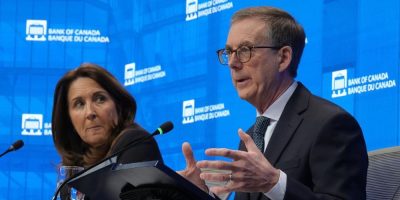
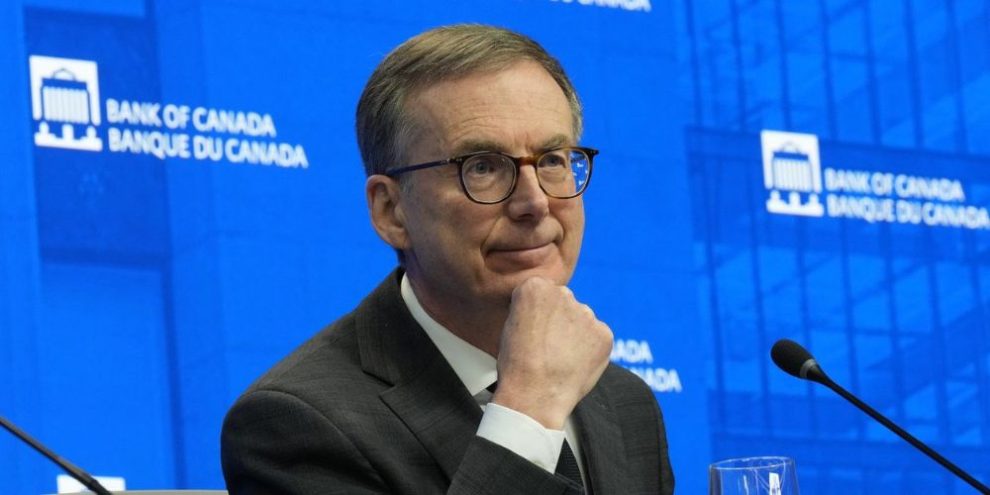
The Bank of Canada kept to the sidelines at its first interest rate decision of the year as it warned the upcoming review of the Canada-U.S.-Mexico agreement and other emerging geopolitical risks are casting a cloud over the central bank's outlook.
The bank held its policy rate steady at 2.25 per cent Wednesday in a move widely expected by economists.
Bank of Canada governor Tiff Macklem said that the economy has evolved broadly in line with the central bank’s expectations since monetary policymakers hit pause on the interest rate easing cycle in December.
But he also warned that uncertainty remains “unusually high."
Barrie's News Delivered To Your Inbox
By submitting this form, you are consenting to receive marketing emails from: Central Ontario Broadcasting, 431 Huronia Rd, Barrie, Ontario, CA, https://www.cobroadcasting.com. You can revoke your consent to receive emails at any time by using the SafeUnsubscribe® link, found at the bottom of every email. Emails are serviced by Constant Contact
Macklem said the bank’s governing council sees the policy rate as “appropriate” based on its outlook, but the “timing or direction of the next change in the policy rate” is difficult to predict.
"Recently you've seen more unpredictability in U.S. policy with all sorts of threats, including on Canada," Macklem said.
This past weekend, U.S. President Donald Trump said he would levy 100 per cent tariffs on Canadian goods if Prime Minister Mark Carney pursues a trade agreement with China.
Canada, the United States and Mexico are also set to review CUSMA, the North American trade pact, in July.
The Bank of Canada's updated monetary policy report released alongside the rate decision Wednesday included various scenarios that could see the partners extend, significantly renegotiate or withdraw from CUSMA entirely depending on the outcome of this year's talks.
An exemption to the United States' blanket tariffs for goods compliant with CUSMA has been critical for Canada's exports heading south of the border, and the central bank warned an end to that reprieve would put the economy on a weaker trajectory.
Macklem said the outcome of CUSMA is also an "important risk to our projection."
He also said fears of eroding central bank independence in the United States could impact the outlook in Canada, given the U.S. Federal Reserve's global role in maintaining financial and price stability. Trump has long been a critic of Fed chair Jerome Powell but the situation escalated earlier this month when the Department of Justice launched a criminal probe into the U.S. central bank.
The U.S. Fed also left interest rates unchanged at its decision Wednesday afternoon.
Macklem reiterated Wednesday that the Bank of Canada is looking to support the economy through its current tariff-driven transition while keeping a lid on inflation.
Tony Stillo, director of Canada economics at Oxford Economics, said that keeping the policy rate at 2.25 per cent offers a bit of a lift to the economy without abandoning the central bank's mandate for price stability.
"Being on the modestly stimulative side ... is appropriate because of the uncertain outlook moving forward," he said.
Coming off strong annual gross domestic product growth in the third quarter, the Bank of Canada now expects the economy stalled in the final quarter of 2025. Swings in export volumes and other business activity responding to tariffs are driving volatility in the quarterly GDP readings, monetary policymakers noted.
The Bank of Canada is expecting annual GDP growth averaged 1.7 per cent last year. Based on a scenario that keeps tariff levels at today's status quo, the central bank sees more modest growth of 1.1 per cent in 2026 and 1.5 per cent in 2027 as businesses adjust to the new trade realities.
Oxford Economics has also mapped out different outcomes for the CUSMA talks.
Stillo said that a resolution that lowers current U.S. tariffs on Canada would allow the central bank to raise its policy rate by about half a percentage point a year from now, while a "much more dark scenario" that sees CUSMA torn up would instead send the economy into a recession. In that instance, Oxford expects another half-point of cuts.
"They would be there for a while because this could have some long-term scarring impacts that are even deeper than are currently baked into the Bank of Canada's views with the current tariffs that we're facing," Stillo said.
The inflation picture is also somewhat messy, thanks to tax changes like the federal government’s two-month tax holiday this time a year ago and ongoing impacts from the end of the consumer carbon price last spring.
But the Bank of Canada broadly sees annual inflation holding around its two per cent target over the forecast horizon as higher costs from trade disruptions are offset by a weaker economy.
As of Wednesday afternoon, financial markets placed the odds of an interest rate cut at the Bank of Canada's next decision on March 18 at just over five per cent, according to LSEG Data & Analytics.
CIBC chief economist Avery Shenfeld said in a note to clients Wednesday that the Bank of Canada appears "firmly neutral" on where interest rates head from this point.
He said CIBC is sticking to its call for no rate changes in 2026, but the odds are tilted toward a further cut rather than a hike, "given the potential minefield in trade negotiations ahead."
TD senior economist Andrew Hencic said in a note that while the rate hold was expected, the central bank's focus on uncertainty surrounding CUSMA and geopolitical risks shows monetary policymakers are taking a data-dependent approach to future decisions.
He said TD's forecast is in line with the Bank of Canada's, with modest growth helping to tame inflation.
"Under these conditions we expect the BoC to stay on the sidelines in the coming months," Hencic said.
This report by The Canadian Press was first published Jan. 28, 2026.