
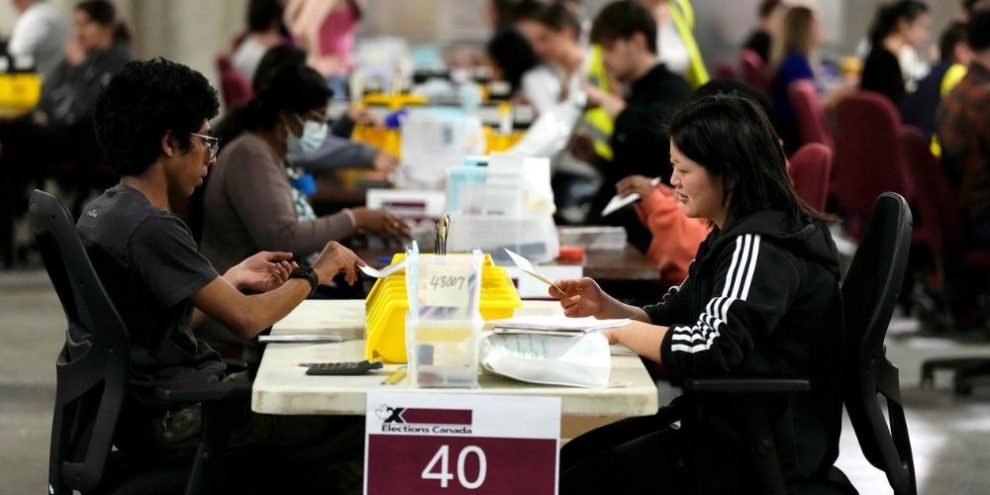
Canadians living abroad are calling for increased turnout among overseas voters and arguing that barriers to casting a ballot could be affecting election results.
Timothy Veale, the director of Grits Abroad — an organization aimed at connecting Canadian Liberal voters living worldwide — said nearly five million Canadians live outside the country and roughly 3.5 million of them are eligible to vote.
Veale said the share of non-resident Canadians voting in federal elections is mired in the low single digits. He said the causes include mail-only voting, compressed timelines, uncertainty about ballot arrival and delivery and a lack of outreach from party campaigns.
Barrie's News Delivered To Your Inbox
By submitting this form, you are consenting to receive marketing emails from: Central Ontario Broadcasting, 431 Huronia Rd, Barrie, Ontario, CA, https://www.cobroadcasting.com. You can revoke your consent to receive emails at any time by using the SafeUnsubscribe® link, found at the bottom of every email. Emails are serviced by Constant Contact
Daniel Scuka, a member of Grits Abroad living in Germany, said parties need to "wake up" and encourage Canadians overseas to vote. He said Elections Canada could also be directed to do more to support overseas voting.
Veale said federal parties should see overseas voters as an opportunity.
"I'd like to see a politician ask us for their vote," he said. "In the last election … I don't think anybody courted any of the five million people living overseas."
Veale said the system "needs modernization" and Canadians should be able to vote in person at an embassy, consulate or high commission. He also pointed out that several countries allow online voting.
"We have the right to vote and a 37-day election was not designed for people abroad to apply to vote," he said. "If you get approval, then you have to wait for the ballot to be sent to you, then you have to send it back. And imagine having to navigate over 200 different national postal systems around the world.
"We've seen how other countries operate and we can do way better than this. It's just a matter of will, as I see it."
Elections Canada said in an email that 101,690 voting kits were issued to electors living outside of Canada in the last general election. Of those, 57,440 were returned on time and tallied.
The agency said 20,013 voting kits were returned too late to be counted, while 411 kits were returned on time but could not be counted for other reasons, such as missing information on the outer envelope.
Elections Canada said 23,826 voting kits were either not returned or cancelled by voters living outside of Canada.
Matthew McKenna, a spokesperson for Elections Canada, said the agency uses its social media channels to inform international voters before and during an election about how to sign up and receive their ballot kits, and to remind them of deadlines.
During elections, he said, the agency's campaign includes web banner ads informing Canadians abroad that they can apply to vote by mail.
International voters can register at any time, he said — even between election campaigns — and Elections Canada immediately issues ballots to all registered voters once an election is called.
Once voters abroad are on the register, they remain there unless they move back to Canada or ask to be removed, he said.
"In recent months, the (chief electoral officer) has shared some reflections on voting by international electors," said McKenna.
"At a November 2025 appearance before the Procedure and House Affairs committee, he noted that the return rate for special ballots issued to pre-registered international electors is significantly higher than that of those who register during the election period."
McKenna said the chief electoral officer recommended extending the minimum election period for non-fixed-date elections, a measure he said would help address the problem of international special ballots arriving after the deadline.
"Currently, the Canada Elections Act provides that an election period must be no fewer than 37 and no more than 51 days in length," McKenna said.
This report by The Canadian Press was first published March 22, 2026.
—With files from Sarah Ritchie