
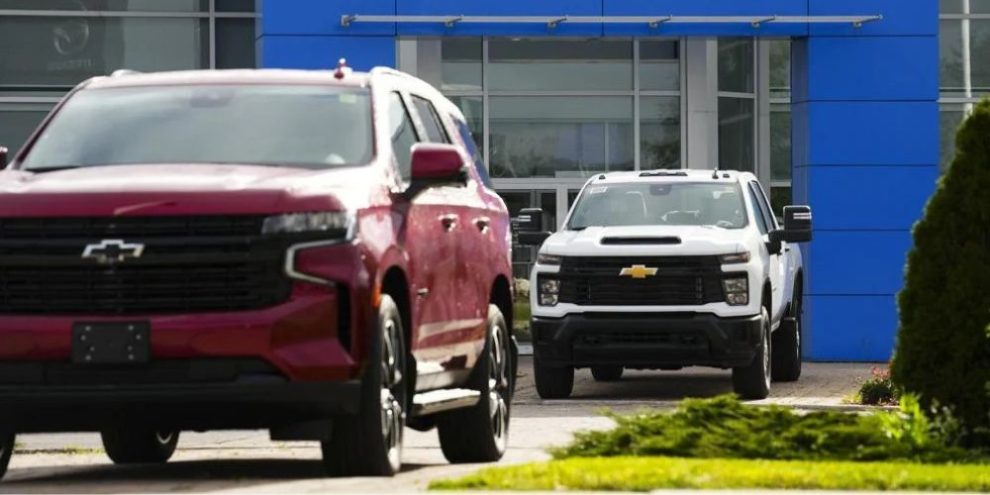
Shopping for a car used to be an exciting occasion, but for some buyers, excitement is getting priced out of the market as they have to dig much deeper to afford it.
Prices have risen so much, the average used car sells for about the same as a new car did in 2018.
Autotrader.ca put the average cost of a new car at $63,264 in the third quarter last year, with a used at $36,911. It doesn't have comparable statistics before 2021, but auto lender Birchwood Credit said the average price of a new vehicle in September 2018 was $36,100, while a used car then was about $19,400.
Tariffs, the impact of COVID-19 on supply chains and broader inflationary pressures have all driven vehicle prices higher, said Iacob Koch-Weser, an associate director for trade and investment at Boston Consulting Group.
Barrie's News Delivered To Your Inbox
By submitting this form, you are consenting to receive marketing emails from: Central Ontario Broadcasting, 431 Huronia Rd, Barrie, Ontario, CA, https://www.cobroadcasting.com. You can revoke your consent to receive emails at any time by using the SafeUnsubscribe® link, found at the bottom of every email. Emails are serviced by Constant Contact
He said that before the pandemic, the automotive industry saw lower input costs for some of the raw materials used in vehicle production, such as steel and aluminum. The trade environment was also very different as it was still based on decades of cross-border integration under free-trade policies.
Then, just as the auto sector was normalizing from supply chain shocks, U.S. President Donald Trump imposed tariffs on steel and aluminum, as well as a blanket 35-per-cent tariff rate that could only be avoided if goods were compliant with the Canada-United-States-Mexico free-trade agreement, or CUSMA.
Previously, many Canadian companies hadn't pursued that designation, deciding the record-keeping and other paperwork wasn't worth the bother when duties were effectively nil.
Exporters rushed to certify their goods after the sudden policy change, with Koch-Weser pointing to “fairly stringent content requirements” for vehicles, some of which have led to higher costs because of required supply chain changes.
“All of that is quite different from where we were around 2018, when there was more (of) a global supply chain with fairly low tariff rates all around,” he said.
Koch-Weser said the tariff shock only adds to other pressures facing consumers.
“The consumer has a more constrained wallet today in general given the higher headline inflation overall and the impact tariffs are having in other consumer-facing industries,” he said.
Daniel Ross, a senior manager of industry insights at Canadian Black Book, said vehicle prices were on a trajectory to recover in 2024 after the market normalized following the pandemic, but then U.S. tariffs put pressure on the market.
Vehicle prices may be near their peak now that the first shock of tariffs has been "digested" through the industry, he said.
Compared with pre-pandemic prices, Ross said the cost of a new car has risen about 30 per cent on average. Though the shifting trade winds played a part, a large part of the increase came before Trump took office.
The worldwide economic shutdown in 2020 created massive upheaval in supply chains around the world, and the auto industry was among the hardest hit.
Ross noted the semiconductor shortage during the pandemic years, when many of those key components went to the consumer electronics industry. That led to shortages of new vehicles and pent-up consumer demand that lasted years. Despite some persistent issues related to semiconductor supply, he said mitigation strategies are now in place.
“Ultimately, our supply chain issues now are almost non-existent. There's still some that comes to and fro, but overall, it's much more diminished than before.”
While supply chain issues and tariffs pushed new car prices higher, the used vehicle market — already disrupted by the limited supply of cars from 2020 and 2021 — has been affected even more, according to Ross.
“The used market has been implicated even more so than the new car market, and that's because now the new car market has moved up so high, used cars are following that trend,” Ross said.
In the past, he said, "you could have the average vehicle price be around the high teens to $20,000 area for a used vehicle that was maybe four years old. But now we're looking in the realm of $30,000 to $35,000 for that same type of vehicle,” he said.
Dave Power, partner and national automotive sector leader at KPMG in Canada, said that one of the major factors influencing the price of new vehicles is that “cars are getting bigger and there’s more in them.”
To afford the higher prices, he said some people are choosing to take on longer terms for leasing or financing, even up to eight years.
“It certainly can add to people's debt load. It certainly also might mean that people have a car for a lot longer than they might anticipate if they're not fully thinking through what that is,” he said.
After experiencing years of higher vehicle costs, Ross said consumers may see some relief this year.
“These high prices ... elevated once again in 2025 because of the tariff impositions and now we're weeding that out a little bit toward the end of this year.”
Power said that where prices go this year will depend largely on the trade situation.
“To the extent that it gets less favourable for North America ... it will get pricier,” he said.
“It is very hard to predict based on where that goes, but 2026 will be a big year for this.”
North America’s trade agreement is scheduled for a formal review in 2026 and it's unclear how negotiations will unfold.
Koch-Weser added that tariff pressures in the automotive industry are unlikely to go away.
Meanwhile, Ross said he thinks prices may go down this year as slowing new vehicle sales in the second half of 2025 continues into the first half of 2026, weighing on prices.
“I believe that things will get more affordable marginally on the new car side and also start to really drop on the used car side as things slow down on the demand front,” he said.
This report by The Canadian Press was first published Jan. 4, 2026.