
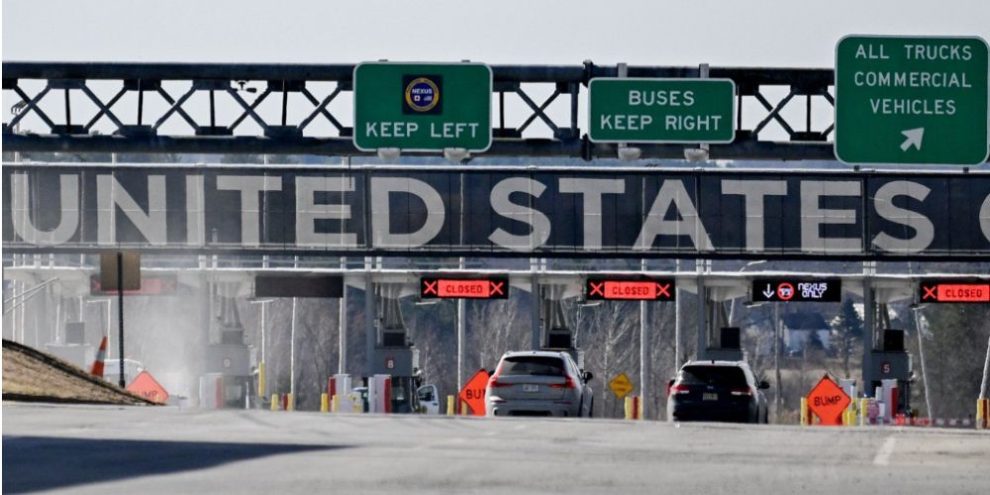
The federal government has updated its travel advice for the United States and is now urging First Nations people to carry a passport in addition to a status card when crossing the border.
Before this week, the government website said First Nations people could "freely" enter the United States for the purposes of employment, study, retirement, investing or immigration.
As of Thursday, the website has been updated with new guidelines.
The website now says First Nations people "may" be able to cross the Canada-U.S. border by land or water with their Secure Certificate of Indian Status, also known as a secure status card.
Barrie's News Delivered To Your Inbox
By submitting this form, you are consenting to receive marketing emails from: Central Ontario Broadcasting, 431 Huronia Rd, Barrie, Ontario, CA, https://www.cobroadcasting.com. You can revoke your consent to receive emails at any time by using the SafeUnsubscribe® link, found at the bottom of every email. Emails are serviced by Constant Contact
The website says acceptance of all status cards is "entirely at the discretion of U.S. officials." Status cards and secure status cards aren't accepted travel documents for air travel, it says.
When crossing the Canada-U.S. border, travellers are strongly urged to carry a valid passport and use a valid machine-readable secure status card, the website says.
The government says that as of February 2019, all new and renewed secure status cards are issued with a machine-readable field. The government began issuing secure status cards in 2009, phasing out older laminated, paper or plastic versions of the cards.
"While you may have previously crossed the Canada-U.S. border with only a secure status card, (Indigenous Services Canada) now strongly recommends also carrying a valid passport when travelling outside of Canada," says the Government of Canada website.
The government says people registered under the Indian Act entering the U.S. to live or work may also be asked to provide documentation to "prove the percentage of Indian blood required under U.S. law."
Mohawk Council of Kahnawake Grand Chief Cody Diabo, who serves as the co-chair of the Jay Treaty Border Alliance and sits in the Iroquois Caucus, said Canada should not be telling First Nations how to conduct themselves at the border and should instead recognize the Jay Treaty.
The Jay Treaty — which Canada does not recognize but the United States does — allows First Nations people born in Canada to freely enter the United States for employment, study, retirement, investment and immigration.
"Before they tell us what we need to cross the border with, they need to recognize that we have the free right by law to cross," Diabo said.
"Our cards are enough with other documents listed in section 289 of the Immigration Act and upheld by the Jay Treaty."
The Assembly of First Nations has warned First Nations people to be wary of crossing the border into the United States due to U.S. immigration enforcement raids and the detention of some Indigenous people.
AFN National Chief Cindy Woodhouse Nepinak has confirmed that at least one First Nations person had a negative encounter recently with U.S. Immigration and Customs Enforcement, better known as ICE, and that person has since returned to Canada.
The case prompted the advocacy body to issue a statement warning First Nations members to make sure they have the right documentation and identification when crossing the border.
In a statement, Indigenous Services Canada said last month it had been made aware that some people have recently reported the confiscation or damage of status cards in the U.S. It said the department can issue emergency status cards and will expedite requests from people who have been affected.
Mississauga First Nation also warned its members against crossing the border, citing ICE’s recent detention of Indigenous people. Three Oglala Sioux Tribe members were detained at a homeless encampment by ICE agents in Minnesota earlier this year.
Several other First Nations have issued similar warnings, including Six Nations of the Grand River near Hamilton, Ont., and Garden River First Nation near Sault Ste. Marie, Ont.
The Jay Treaty Alliance, a body representing tribal governments and First Nations communities on both sides of the border, is encouraging First Nations people crossing the border to the U.S. to ensure they are carrying their familial lineage letter, status card, long-form birth certificate and government-issued photo ID.
U.S. tribal members are being encouraged to carry their tribal IDs, state-issued IDs or driver’s licences, or a U.S. passport.
This report by The Canadian Press was first published Feb. 20, 2026.
—With files from Alessia Passafiume