
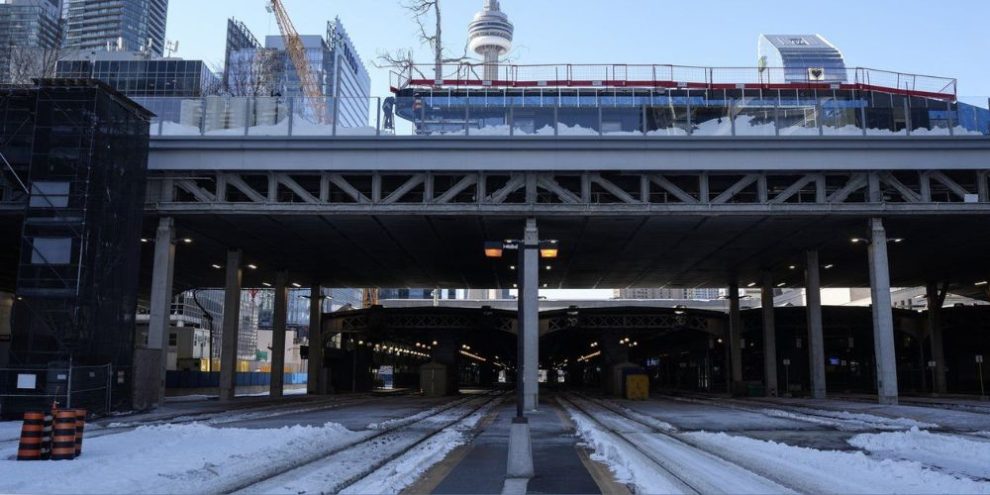
A new report has found an overreliance on visual inspections of the train tracks may have contributed to the derailment of a GO Transit train at Toronto’s Union Station that disrupted commuter travel for days earlier this year.
The report recently released by Metrolinx confirms an initial investigation that found the Feb. 2 derailment was caused by missing screws on a railway track just outside the station.
It says two screws were installed per plate at the site, while four were required under new standards implemented last year.
As well, it says the screws across nine consecutive timber ties were loose, missing or degraded, making the fastening system unable to hold the rail in place. As a result, the rail shifted about 3.5 centimetres.
Barrie's News Delivered To Your Inbox
By submitting this form, you are consenting to receive marketing emails from: Central Ontario Broadcasting, 431 Huronia Rd, Barrie, Ontario, CA, https://www.cobroadcasting.com. You can revoke your consent to receive emails at any time by using the SafeUnsubscribe® link, found at the bottom of every email. Emails are serviced by Constant Contact
The report says the investigation found "limitations associated with relying primarily on routine visual inspections to identify track infrastructure degradation," including that they cannot "reliably determine the remaining holding strength or clamping effectiveness" of the screws.
It also says that conducting geometry testing on an annual basis makes it difficult to spot fastening degradation that develops in between the tests, noting the derailment took place before the next scheduled geometry inspection cycle.
"The combination of visually based inspections, limited inspection prompts, annual geometry testing intervals, and discretionary use of enhanced testing methods reduced the likelihood of identifying track infrastructure irregularities and progressive fastening degradation before the condition escalated into a derailment risk," the report says.
Metrolinx CEO Michael Lindsay discussed the findings at the agency's board meeting Thursday, saying no mechanical deficiencies or non-compliant actions by the train crew were identified.
"The cause, therefore, was a legacy infrastructure condition that developed progressively over time," he said.
The agency has continued to check that a similar condition doesn't exist elsewhere on the railway and has updated its protocols to strengthen inspections, he said.
No injuries were reported at the time of the derailment, and Metrolinx said it would issue automatic fare refunds to some GO train riders after the derailment caused major delays.
This report by The Canadian Press was first published Sept. 11, 2026.