
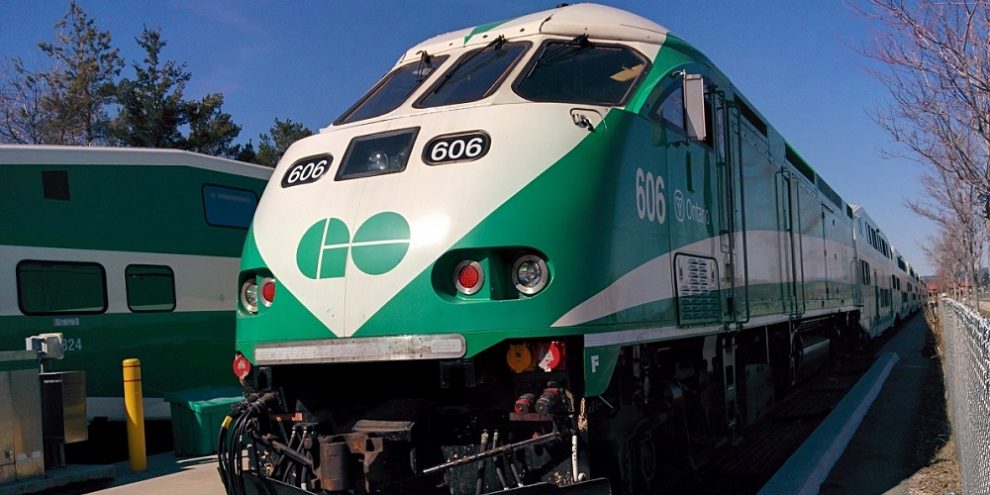
GO Transit riders in Barrie and across Ontario are on the same network where a near-catastrophic collision played out two years ago, and a new federal report says the safety system that could prevent a repeat still isn't in place.
The Transportation Safety Board of Canada released its findings this week into a close call near the Aldershot GO station in Burlington on March 14, 2024. Two GO trains came within 167 metres of each other after one passed a stop signal and ended up on a track where another train was travelling in the opposite direction. More than 400 passengers were on board between the two trains.
Barrie's News Delivered To Your Inbox
By submitting this form, you are consenting to receive marketing emails from: Central Ontario Broadcasting, 431 Huronia Rd, Barrie, Ontario, CA, https://www.cobroadcasting.com. You can revoke your consent to receive emails at any time by using the SafeUnsubscribe® link, found at the bottom of every email. Emails are serviced by Constant Contact
What went wrong
The TSB found that the crew departing from Aldershot believed the oncoming train had already passed, and expected the signal to clear. It didn't.
The conductor was focused on his tablet during departure preparations. The locomotive engineer was dealing with equipment issues in the cab. Neither saw the stop signal.
RELATED: Missing track screws may have caused GO train derailment in Toronto: Metrolinx ...
Both trains were halted by their crews before they hit, but the gap between them was roughly the length of a city block and a half.
The bigger problem
The TSB isn't just pointing at crew distraction. The board says this incident illustrates a much older issue: Canadian commuter rail doesn't have automatic, physical systems that stop trains when crews fail to respond to signals.
"In this occurrence, a catastrophic collision involving 400 passengers was narrowly averted, underscoring the need for physical fail-safe train controls that can intervene when signal indications are not followed," said TSB chair Yoan Marier.
"For more than 25 years, we have been calling on industry and regulators to expedite the implementation of physical fail-safe train control systems and put strong interim measures in place while these systems are being developed and installed."
RELATED: Metrolinx CEO apologizes to GO train riders for delays since train derailment ...
These systems, sometimes called positive train control, automatically slow or stop a train when a crew doesn't act on a signal. The United States fully implemented them on high-hazard routes in 2020, including lines operated by CN and CP. Canada has not.
Since 2023, the TSB has investigated eight separate collisions or near-collisions where signal indications were not followed.
What it means for GO train passengers
The Barrie GO line connects Allandale Waterfront to Union Station, running through the same network involved in the Burlington incident. The TSB's report doesn't single out the Barrie corridor, but the call for system-wide physical fail-safes applies across GO Transit.
There's no indication from Metrolinx or Transport Canada that a timeline for implementing those systems on Ontario commuter rail has been set.
*With files from CP