Iran launched more missiles at Israel and U.S. bases as the war in the Middle East enters a sixth day. Israel announced multiple incoming attacks early Thursday and said it was intercepting the missiles.
Meanwhile, the Israeli military said it began new strikes against the Iranian-backed Hezbollah militant group in Lebanon. At least eight people were killed there late Wednesday into Thursday according to Lebanon’s Health Ministry and the state news agency.
Tehran has warned of the destruction of the Middle East’s military and economic infrastructure, and the war has rattled financial markets, with most taking their cues from what the price of oil is doing. Early Thursday, oil prices resumed their ascent.
The war has killed at least 1,230 people in Iran, more than 70 in Lebanon and around a dozen in Israel, according to officials in those countries. Six U.S. troops have been killed.
Here is the latest:
Sri Lanka evacuates over 200 sailors from another Iranian warship near its coast
Authorities in Sri Lanka were informed that one of the ship’s engines suffered a failure, the country’s president said Thursday.
The decision to take the crew ashore and the IRIS Bushehr to a Sri Lankan port comes a day after a U.S. submarine sank another Iranian warship off the island’s coast, said President Anura Kumara Dissanayake. He said his government held discussions with Iranian officials and the captain of the ship.
Sri Lankan officials say 87 bodies were recovered and 32 people rescued from the roughly 180 people believed to have been aboard to IRIS Dena sunk Wednesday.
Macron urges halt to Israel-Hezbollah fighting
French President Emmanuel Macron is urging the Lebanese militant group to stop attacking Israel and warned Israel against a ground operation in Lebanon.
“Hezbollah must immediately cease its fire toward Israel. Israel must refrain from any ground intervention,” Macron wrote on X.
He said he spoke with Trump, Israeli Prime Minister Benjamin Netanyahu and Lebanese leaders in what is apparently the first diplomatic initiative to try to end the conflict in the tiny country.
Operations at WHO’s crucial Dubai hub are ‘temporarily on hold’
The World Health Organization says the pause is due to insecurity, airspace closures and restrictions on the Strait of Hormuz. It’s looking into possible land-based alternatives.
Its eastern Mediterranean chief, Dr. Hanan Balkhy, said the disruption is preventing access to $18 million worth of humanitarian health supplies, while $8 million in shipments cannot reach the hub.
More than 50 emergency supply requests from 25 countries are affected, while $6 million in medicines for Gaza and $1.6 million in polio laboratory supplies are also held up, she said.
WHO has not received any formal requests from Iranian authorities for specific supplies because Iran’s system is “withstanding the current situation,” she said.
The hub last year fulfilled over 500 emergency orders for 75 countries worldwide.
Israel’s UN envoy on calls to end Iran war: ‘Not yet’
Israel’s ambassador to the United Nations said Thursday it is too soon for diplomacy, as calls grow to end the widening war with Iran.
Danny Danon told reporters Israel must first eliminate Iran’s nuclear program, ballistic missiles, regional proxies and naval threats.
“I think diplomacy will come into action — not yet, not yet,” Danon said. “We have to finish the job.”
He said Israel must continue “to hammer, to dismantle” Iran’s capabilities before turning to diplomacy, adding that he expects the war to last days or weeks, not months.
Danon also said the 2015 Iran nuclear deal failed and that new “effective mechanisms” are needed to prevent Iran from becoming a threat again.
Meet Pedro Sánchez, Europe’s most vocal critic of Trump’s attacks on Iran
Spain’s prime minister has drawn the U.S. president’s ire for refusing to let America use Spanish bases to support strikes on Iran.
On Tuesday, Trump threatened to cut off all trade with Spain. On Wednesday, Spain’s foreign minister rejected a White House claim that Spain will cooperate.
Sánchez has condemned Iran’s repression but calls the war unjustified and says Spain will not act out of fear.
The fight deepens a broader rivalry. The 54-year-old Sánchez has criticized Israel’s war in Gaza and resisted higher NATO spending while backing legal migration.
▶ Read more about one of Europe’s most prominent left-leaning leaders
US Embassy in Pakistan issues a security alert ahead of possible protests
The alert did not specify the cause of Friday's anticipated demonstrations, but comes days after Pakistani demonstrators supportive of the Iranian government attempted to storm a U.S. consulate, leading to violent clashes in Karachi and elsewhere that left 22 people dead.
The embassy’s warning Thursday restricts the movement of its personnel nationwide.
Trump wants to be involved in picking the next Iranian leader
Trump in an interview with the news outlet Axios said he wants to be involved in selecting Iran’s next leader and called Ayatollah Ali Khamenei’s son an “unacceptable” potential pick.
“Khamenei’s son is unacceptable to me,” Trump said of Mojtaba Khamenei, the 56-year-old son of the supreme leader killed on the first day of the war. Trump added, “We want someone that will bring harmony and peace to Iran.”
The president also derided him as “a lightweight.’
“I have to be involved in the appointment, like with Delcy in Venezuela,” said Trump, referring to the acting president in the South American country, Delcy Rodríguez, who took power after Trump had the U.S. military capture Nicolás Maduro to face U.S. drug conspiracy charges.
Barrie's News Delivered To Your Inbox
By submitting this form, you are consenting to receive marketing emails from: Central Ontario Broadcasting, 431 Huronia Rd, Barrie, Ontario, CA, https://www.cobroadcasting.com. You can revoke your consent to receive emails at any time by using the SafeUnsubscribe® link, found at the bottom of every email. Emails are serviced by Constant Contact
Bahrain says an Iranian missile hit a state-run oil refinery
Bahrain said the fire Thursday night was extinguished without injuries and the refinery was still working.
But it marked yet another Iranian strike targeting the region’s oil industry, the lifeblood of the Gulf Arab states.
Air raid sirens sounded across Bahrain earlier Thursday, with residents urged to seek shelter, and mobile phones had alerted people in Dubai of possible missile fire from Iran. Authorities in the tiny Gulf nation said a facility in the oil refining and factory town of Maameer had suffered minor damage, with no casualties.
Bahrain’s defense ministry said its forces intercepted 75 Iranian ballistic missiles, destroying 65 while 10 fell inside its territory. It also reported intercepting 124 drones, downing 88 while 36 landed within the country.
Around 20,000 Americans have left the Middle East, State Department says
And nearly all made their own way out, without government assistance, the State Department said.
The department said the first charter flight it arranged for private citizens who want to leave departed Wednesday, with several more expected Thursday. Officials did not say where they would depart, but the department asked Americans in Bahrain, Israel, Kuwait, Qatar, Saudi Arabia and the United Arab Emirates to fill out an online form for information.
Officials said they have responded to requests for information from more than 10,000 Americans in the region, but did not say how many want to leave. Americans seeking help were urged to contact an emergency task force at +1-202-501-4444.
Iranians trickle across the border with Turkey
A steady stream of Iranians were crossing the border into Turkey on Thursday after the frontier was closed for much of the day before. Most already had links to Turkey.
Elyar Akbari, a 22-year-old from Tabriz, Iran, is a student in Turkey’s western city of Izmir. He cut short a visit home, leaving his family behind.
“I don’t believe that Iranians will leave their country,” he said. “Only students or people who already work in Turkey will come for now.”
Kadir Ozel, 40, a Turkish citizen living in Tabriz, crossed to drop off his children, who will stay with their grandmother and uncle in Ankara.
“They were very scared. But I have to go back for work,” he said.
A woman who asked to be identified only by her first name, Fariba, out of security concerns, crossed to wait out the war with her son in Izmir. But her neighbors have no money, “so they stay home, and they are scared,” she said.
— By Serra Yedikardes
Nearly 25,000 flights canceled since the start of the war
That's more than half of the roughly 44,000 flights scheduled to fly in and out of the Middle East between Saturday and Thursday, according to the latest numbers from aviation analytics firm Cirium.
Flight-tracking service FlightAware reported about 2,050 flight cancellations worldwide as of around 11 a.m. ET Thursday, following more than 2,600 cancellations on Wednesday. Dubai International Airport, a major hub, continued to see the largest number of disruptions.
Settler attacks rise in West Bank as Israel tightens restrictions during war with Iran
Violence by Israeli settlers against Palestinians in the occupied West Bank has increased since Iran war erupted, a leading Israeli rights group said Thursday.
Yesh Din said it documented 50 instances of settler violence in 37 Palestinian communities throughout the West Bank from Saturday to Tuesday, including shootings, assaults and property damage. “Under the cover of the war, settler violence is escalating with the aim of forcing Palestinians out and taking over their land,” its statement said.
That includes Israeli settlers who shot and killed two Palestinian brothers in the West Bank village of Qaryout, injuring others. An ambulance couldn’t reach them because Israel has closed gates and checkpoints, citing security.
Israel’s Smotrich threatens to make Beirut’s southern suburbs look like Gaza
Israel’s far-right finance minister Bezalel Smotrich warned Thursday Beirut's southern suburbs where Hezbollah has a strong presence will look like Khan Younis, a city in Gaza that Israel has decimated.
The Israeli military's evacuation notice Thursday called for all residents of the area to “save your lives and evacuate your homes immediately,” apparently signaling plans for heavy bombardment.
“You wanted to bring hell on us, we are bringing hell on you,” Smotrich, a hawkish conservative force in Netanyahu’s government who had opposed several ceasefires in Gaza, said as he toured towns on Israel’s border with Lebanon. “Dahiyeh will look like Khan Younis, and our citizens of the north will live in peace and quiet.”
Iran awaits announcement of a new leader
Some disagreements are emerging from the confidential discussions over who will be Iran’s next supreme leader.
Rumors have long swirled around the possibility of Mojtaba Khamenei succeeding his father, since he's close with the all-powerful Revolutionary Guards.
A member of parliament and firebrand cleric, Hamid Rasaee, wrote Thursday that the killed supreme leader’s son was “an outstanding seminarian” as well as a trusted adviser to his father and an “overseer of many of the country’s affairs.” He also called Khamenei an ayatollah, a rank he may not possess.
A reformist-aligned cleric, Rahmatollah Bigdeli, condemned what he called Rasaee’s “ignorance and bias.”
“The constitution does not specify a time limit for the validity of the interim leadership council, and questioning the validity of this council is tantamount to questioning the legitimacy of the decision-making bodies of the regime,” he replied on X.
A former minister also aligned with Iran’s reformists, Abbas Akhoundi, warned against “a diversionary and toxic debate” over the succession.
“The stench of the power struggle in wartime is nauseating,” Akhoundi wrote on X.
Death toll in Lebanon surpasses 100
At least 102 people in Lebanon have been killed since the onset of the latest conflict between Israel and the Hezbollah militant group, Lebanon’s health ministry said in a statement. At least 638 others were wounded, the ministry said Thursday.
The latest conflict between the two sides was sparked by Hezbollah firing rockets into northern Israel early Sunday. Israel has been striking large swaths of the country in response.
Airlines restore some limited flights
As some airspace reopened, Emirates Airlines said Thursday that it was restoring a limited schedule of flights in and out of Dubai. The carrier said it would continue to monitor developments and urged customers not to go to the airport unless their flights were confirmed.
Meanwhile, Israel’s Ben-Gurion Airport continued a phased reopening. Tel Aviv-based El Al said that it started “proactively assigning” customers who are currently abroad to recovery flights back to Israel, but noted that its outbound flights were still not operating as of Thursday.
Tumult in Tehran as bombing continues
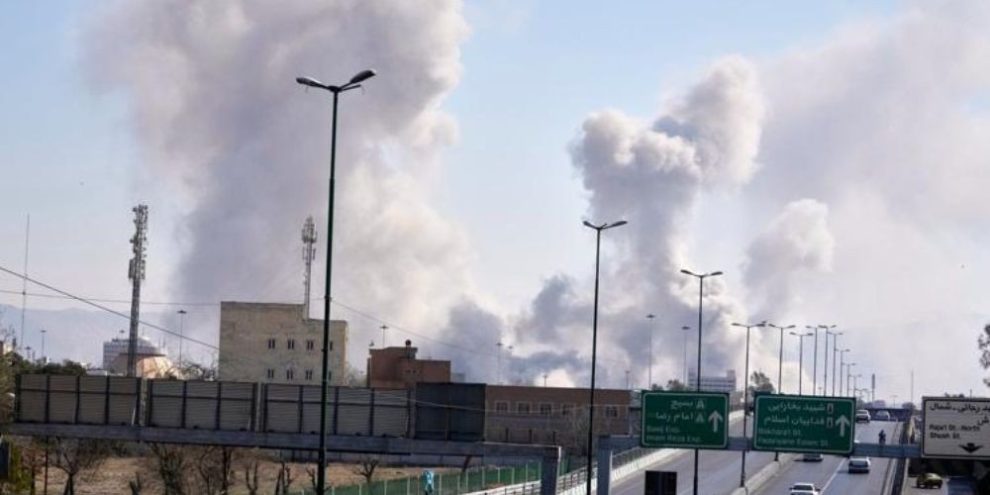
As the war entered its sixth day Thursday, an Iranian state-owned newspaper called Iran reported bombings at a police station and even a gym in Tehran, as residents shuttled to grocery stores, pharmacies and gas stations to buy supplies and fill their tanks.
Tehran’s governor, Mohammad-Sadegh Motamedian, urged citizens to avoid stockpiling necessities to keep markets calm. Authorities said they were equipping dozens of subway stations to serve as bomb shelters, as they did during the 12-day war last June.
Ongoing, widespread bombing forced authorities Thursday to cancel a planned tour for journalists of a damaged area of the capital.
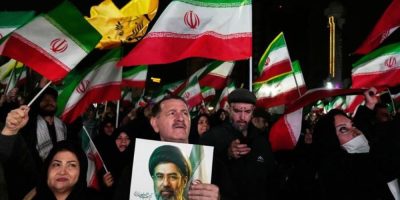
Funerals for dead Iranian security officers were held around the country, including in Kerman, Isfahan and Tabriz. Hard-liners also gathered in town squares and intersections to mourn and express support for the theocracy while religious songs blared from their cars.
Iran says 4 health workers killed and 11 hospitals damaged by US-Israeli strikes
Iran’s Health Ministry Spokesman Hossein Kermanpour said Thursday in a post on X that the strikes have damaged critical parts of the country’s health system, and killed a resident orthopedic, a radiology technician, a general practitioner and an emergency medical technician.
He said the damage has also affected emergency services and ambulances.
The economy in northern Israel sputters after years of evacuations during Gaza war
Businesses have closed, wineries have shuttered and tourists who once flocked to the Galilee’s rolling hills have yet to return. Repeated evacuations drove down spending and left fatigue in Israeli towns like Kiryat Shmona. Israel’s military said two soldiers were wounded Wednesday by fire from Hezbollah. In Lebanon, at least 77 people have been killed and tens of thousands displaced, both within the country and into Syria.
Memories of previous evacuations remain fresh in towns near the Lebanese border as Israeli tanks moved north Thursday.
“We’ve already been through two complicated years,” said Oscar Chen of Kiryat Shmona. “There are children here, and there are elderly people who don’t have the time to run, nor the strength and ability if the shelter is far.”
Chaos sown by Iran’s attacks across the Persian Gulf is key to its strategy
For years, Iran’s theocratic government warned it would blanket the Middle East with missile and drone fire if it felt its existence was threatened.
Now, it’s doing just that. Since the U.S. and Israel launched the war Saturday, Iran has unleashed thousands of missiles and drones at Israel, American military bases and embassies, and energy facilities across the Gulf.
Its basic strategy is to instill fear about the dangers of a widening war in hopes that allies of the U.S. and Israel will apply enough pressure to halt their campaign. There is a risk, though, that the barrage-thy-neighbors strategy could backfire.
There’s also a grim math equation at play. Iran has a finite number of missiles and drones, just as the Gulf Arab states, the U.S. and Israel all have a limited number of interceptor missiles capable of downing the incoming fire.
▶ Read more about Iran’s war strategy
Beirut’s streets snarl as residents flee
The exodus comes after the Israeli military warned residents of the southern suburbs of Lebanon’s capital to “save your lives and evacuate your homes immediately,” signaling plans for heavy bombardment.
Hadi Kaakour, a fleeing resident, said he wasn’t sure leaving would make him safer.
“We don’t put anything past them,” he said, referring to Israel. “They will strike us no matter where we go.”
Some residents voiced anger that Lebanon has been pulled into the wider war.
“We got sucked into a mess that we have nothing to do with,” said Yousef Nabulsi, who was also fleeing. “People have been displaced and are now staying on the streets.”
Nearly 84,000 people had already been displaced since fighting between Israel and Hezbollah resumed Monday.
Taiwanese citizens return and recount the tension of the war
A total of 252 Taiwanese citizens arrived Thursday in Taipei from Dubai, days after being stuck in cities under attack by Iran.
Tim Liu, a 34-year-old financial analyst, was traveling with his girlfriend in Dubai for a week.
“It was very tense when the attack happened. We heard explosions. I kept checking the flight status and immediately changed my ticket back to Taiwan. Luckily, everything went smoothly,” he said.
Qatar says it was attacked by a salvo of Iranian missiles and drones
The Gulf nation’s defense ministry said 14 ballistic missiles and four drones were fired at the county.
It said air defenses intercepted all the drones and 13 of the missiles, while the 14th fell in the sea off Qatar.
Iranian state television announced Thursday night that the salvo of missiles had been launched.
Oil prices start climbing again after stabilizing a day earlier
“Yesterday’s bounce in risk assets already looks less like a turning point and more like a classic relief rally in a market that briefly inhaled before realizing the room was still on fire,” Stephen Innes of SPI Asset Management said in a commentary.
Uncertainty about the war in the Middle East has rattled financial markets, with most taking their cues from the price of oil.
U.S. benchmark crude jumped by $2.59 per barrel, or 3.5%, to $77.25, the highest in more than a year. Brent, the international standard, gained 2.8% to $82.87 per barrel. Prices at U.S. pumps are up nearly 10%.