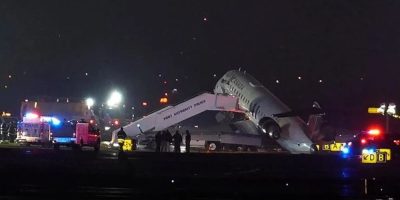
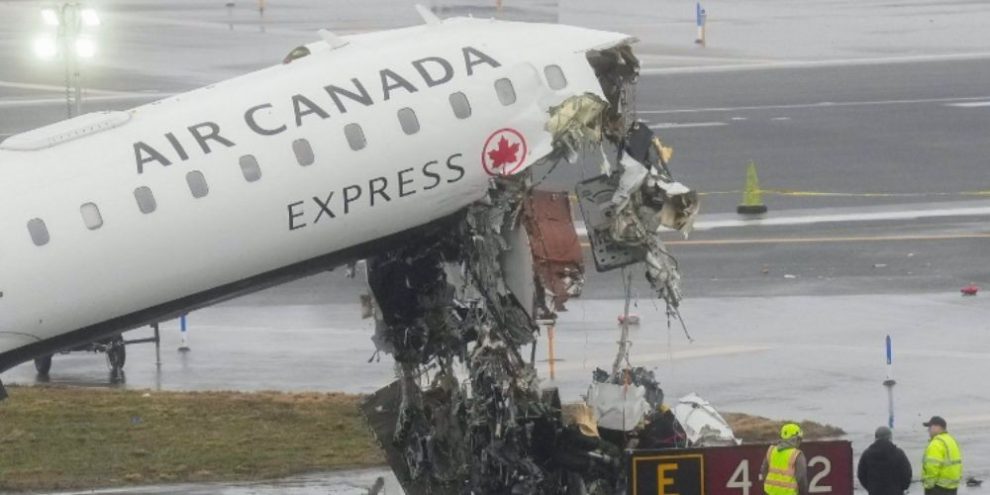
As investigators pore over the site where Air Canada Flight 8646 crashed on Sunday night at LaGuardia airport in New York City, a review of publicly available air traffic control radio transmissions offers a glimpse into what controllers were dealing with in the moment before the crash — and the sorrow of one controller in the aftermath.
All times Eastern.
10:35 p.m.: Air Canada Flight 8646 departs Trudeau International Airport in Montreal en route to LaGuardia.
The CRJ-900, operated by Jazz Aviation, leaves for New York with 72 passengers and four crew members.
11:21 p.m.: United 2384 first reports odour, says it's going back to the gate and requests fire support.
A United Airlines flight on the ramp at LaGuardia first signals to air traffic control its request for fire support. They are in communication with a different controller than the one which would later issue the clearances for both Flight 8646 to land and for the fire truck to enter the runway.
The United flight had aborted its take off procedure twice already and was trying to return to its gate, though it was struggling to get information on which gate.
Another flight reports it can confirm a sewer smell "going around the terminal" as it was taxiing.
Barrie's News Delivered To Your Inbox
By submitting this form, you are consenting to receive marketing emails from: Central Ontario Broadcasting, 431 Huronia Rd, Barrie, Ontario, CA, https://www.cobroadcasting.com. You can revoke your consent to receive emails at any time by using the SafeUnsubscribe® link, found at the bottom of every email. Emails are serviced by Constant Contact
11:32 p.m.: United flight 2384 declares emergency because of odour, says flight attendants are feeling ill and requests “any available gate."
Still unable to get to a gate to deplane the aircraft, the United flight declares an emergency. The crew reconfirms its request for fire support and for air stairs in case it needs to deplane on the ramp.
11:35 p.m.: Tower clears Air Canada Flight 8646 to land on Runway 4.
The Air Canada flight, inbound for LaGuardia, receives its landing clearance from the control tower.
24 seconds before impact: United flight confirms it has a gate.
The United flight confirms to air traffic control it has a gate to which it can taxi. This communication means it likely no longer needs fire support, though emergency crews are already en route.
19 seconds before impact: Tower clears “Truck 1 and company” to cross Runway 4.
The fire truck, with other emergency personnel in tow, arrives at the side of Runway 4 and radios the tower for clearance to cross. Air traffic control issues the clearance, as Flight 8646 is inbound.
9 seconds before impact: The first calls come in for the fire truck to stop.
The air traffic controller — who had issued clearances to both Flight 8646 to land, and for the fire truck to cross the runway — frantically calls on the fire truck to stop. He can be heard saying "stop" more than 10 times.
11:37 p.m.: Impact.
Air Canada Flight 8646 collides with the fire truck as it rolls down the runway after touching down.
Emergency crews respond and immediate close the runway and subsequently the airport.
The two pilots are killed in the crash.
11:55 p.m.: “I messed up,” ATC controller says.
Radioing other planes on the ground to direct them to return to the ramp, and notifying them that the airport closure will last a while, the air traffic controller appears dejected.
"That wasn't good to watch," says a Frontier Airlines pilot to the controller.
"Yeah, I know. I was here. I tried to reach out. But we were dealing with an emergency earlier. Ah, I messed up," the controller says.
"Nah man, you did the best you could," the pilot responds.
This report by The Canadian Press was first published March 23, 2026.