Indigenous leaders struck a resolute tone Wednesday as the country marked the National Day for Truth and Reconciliation following reports of a white supremacist demonstration in a First Nations community in the B.C. interior.
"Survivors have fought for decades to defend their truths and confront the distortion of history, while our legal system still fails to recognize denialism for what it is — hatred disguised as free speech," Stephanie Scott, executive director of the National Centre for Truth and Reconciliation, told a gathering on Parliament Hill.
"All of you hold the power to honour survivors and demand accountability, not only from our leaders but from one another. Truth and reconciliation is an ongoing responsibility, a human rights obligation and a sacred commitment."
Roseanne Casimir, chief of Tk̓emlúps te Secwépemc First Nation, said on Sunday a group of masked individuals dropped a banner from an overpass in Kamloops, B.C. The banner — bearing the words "Got bones?" — appeared to be questioning reports of human burials at the former sites of residential schools.
In May 2021, the First Nation announced ground-penetrating radar had uncovered what were believed to be 215 unmarked graves at the site of the former Kamloops Indian Residential School. That news made international headlines and led to the community being attacked online.
Some outside individuals reportedly brought shovels to the community and the First Nation was forced to increase security around the site of the former school.
Researchers at the National Centre for Truth and Reconciliation have identified 63 children who died at the former Kamloops Indian Residential School. Their names and dates of death are listed by the organization.
Beginning in the 19th century, more than 150,000 Indigenous children were separated from their families and communities and sent to church-run residential schools where abuse, malnutrition and inadequate health care were rampant.
The Truth and Reconciliation Commission concluded in its landmark 2015 final report that the school system was a central element of a state-backed policy of cultural genocide.
Barrie's News Delivered To Your Inbox
By submitting this form, you are consenting to receive marketing emails from: Central Ontario Broadcasting, 431 Huronia Rd, Barrie, Ontario, CA, https://www.cobroadcasting.com. You can revoke your consent to receive emails at any time by using the SafeUnsubscribe® link, found at the bottom of every email. Emails are serviced by Constant Contact
The Truth and Reconciliation Commission initially documented the deaths of 3,200 children at residential schools. Experts at the National Centre for Truth and Reconciliation — who continue to comb through millions of records — say the actual number could be much higher.
The establishment of the National Day for Truth and Reconciliation on Sept. 30 was among the recommendations in the Truth and Reconciliation Commission's report. It's meant to honour the survivors of residential schools and those who never made it home.
CBC/Radio-Canada, APTN and the National Centre for Truth and Reconciliation hosted the annual Remembering the Children event on Parliament Hill.
Bernard Andreason, a survivor who has written a book describing how he and two friends fled the Stringer Hall Residential School in Inuvik, told the crowd in Ottawa that it was inspiring to hear from survivors who speak their own languages.
"'Take the Indian from the child.' You can't do that. It's next to impossible," he said.
Andreason said many communities today are "working towards a better education for our children" so they can be at home while they go to school.
Jacquie Bouvier, a third-generation survivor and a member of the survivors circle at the National Centre for Truth and Reconciliation, told Indigenous youth in the crowd they carry the strength and love of previous generations.
"Every time we speak our languages, share our teachings, gather with one another as Indigenous Peoples, we reclaim something that was meant to be taken from us," she said.
Gov. Gen. Louise Arbour told the gathering Canada must "confront all forms of denialism that persist, despite extensive historical records."
"Remembering is only one step. It must be accompanied by a commitment to ensuring that injustices are never, ever repeated," Arbour said.
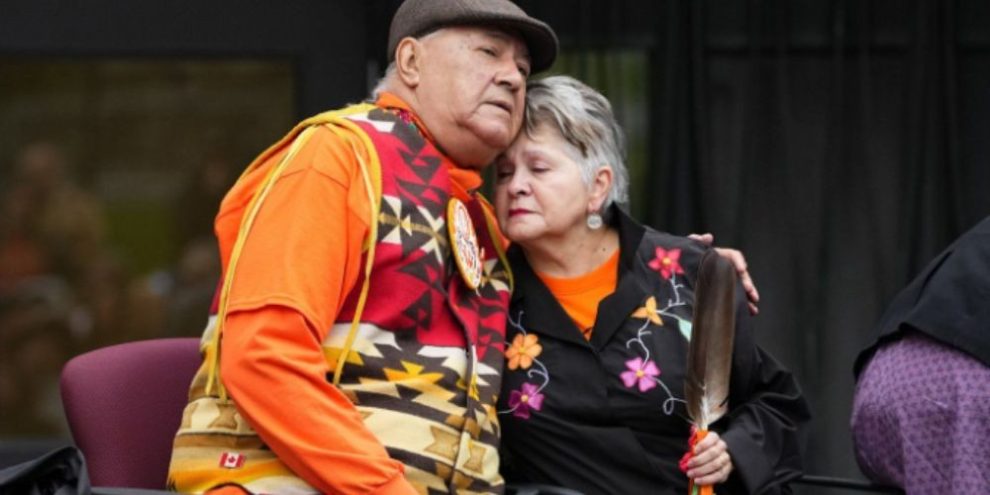
Guests and participants at the Parliament Hill event were encouraged to bring a pair of children's shoes to place at the front of the stage to honour the children who attended residential schools.
Arbour added a small pair of orange moccasins to the display as a 60-metre-long cloth bearing the names of children who died as a result of residential schools was carried through the crowd.
A number of people in attendance held one another and wiped away tears as the memorial cloth was presented.
Separate events to mark the day took place across the country, including in Toronto, Vancouver, Calgary and Iqaluit.
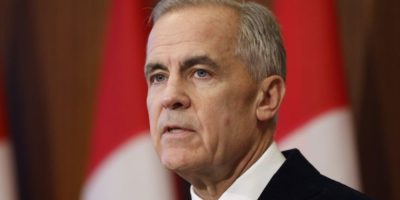
Prime Minister Mark Carney spoke at an event in Edmonton.
He issued a statement before the event in English, French and nine Indigenous languages, including Algonquin, Denesuline, Innu-Aimun, Inuktitut (Northern Baffin), Mi’kmaq, Michif, Oji-Cree, Plains Cree, and Western Ojibway.
In his speech, Carney said we shouldn't choose which parts of history we remember.
"We shouldn't admire the beadwork and forget the children that were forced into uniforms. We shouldn't honour the drum and ignore the years that it was made to fall silent," he said. "And we should not hear the truth of residential schools and fail to act on it."
Only 14 of the Truth and Reconciliation Commission's 94 calls to action have been completed in the last 11 years, according to independent monitor Indigenous Watchdog. Another 41 recommendations are considered in progress, while 24 are stalled and 15 have not been started.
Scott said people around the world are looking to Canada for guidance, but the country still has a very long way to go.
"We are seeing a rising wave of residential school denialism, racist diatribe that tries to dehumanize us and incite violence," Scott said.
"But we are better than that, and we are stronger than that because we know our own power."
This report by The Canadian Press was first published Sept. 30, 2026.