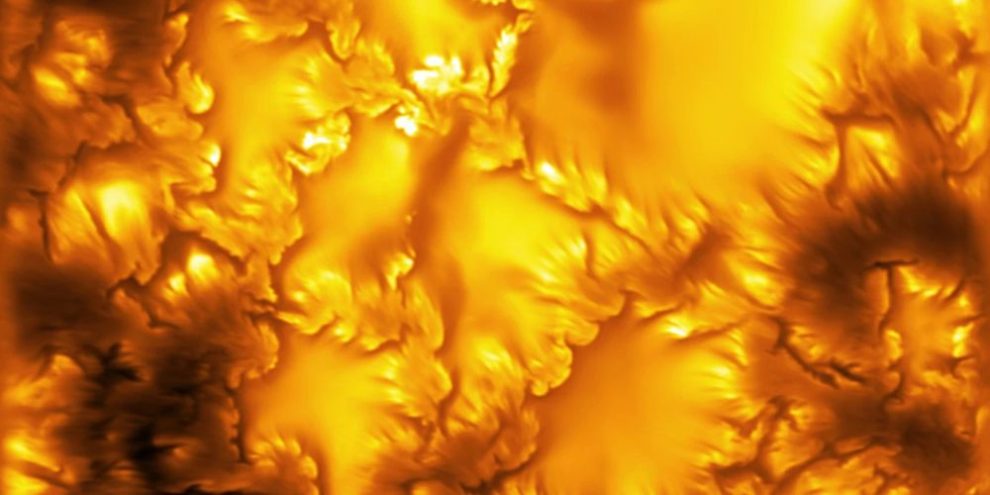
Scientists have captured the most detailed images ever taken of the sun’s surface, unveiling previously unseen patterns rippling across its blazing exterior.
The images were recorded using the National Science Foundation’s Daniel K. Inouye Solar Telescope on Maui, Hawaii. Researchers initially gathered the data to test and fine-tune the telescope’s capabilities, but the results ultimately provided an unprecedented view of the sun’s bright outer layer.
Among the most striking discoveries were unusual feathery structures stretching across the solar surface.
“That reminds me of famous paintings, like the swirling skies in Van Gogh’s Starry Night,” said solar physicist Ruizhu Chen with Stanford University, who was not involved with the new research.
Telescope captures unprecedented solar detail
Looking directly at the sun is dangerous without proper eye protection, but powerful scientific instruments allow researchers to study the star in remarkable detail.
When scientists reviewed the images from the Inouye Solar Telescope, they found they had captured the sun’s surface at a higher resolution than ever before.
The enhanced view revealed intricate motions and patterns that had never been observed at this scale.
Scientists identify ripples caused by moving plasma
Researchers determined the strange rippling features are linked to instabilities created when streams of magnetized plasma move past one another at different speeds.
The process is similar to waves forming on the surface of water when wind blows across it. Scientists have long understood the phenomenon and have observed it on Earth as well as on planets including Jupiter and Saturn.
However, seeing it so clearly on the sun is something new.
“It has not been observed ever at that level on the solar surface,” said study co-author Friedrich Wöger with the National Solar Observatory.
The findings were published Wednesday in the journal Nature.
Better understanding the sun helps predict space weather
Researchers are working to better understand the sun’s internal dynamics because solar activity can have real impacts on Earth.
Scientists closely monitor massive bursts of energy known as coronal mass ejections, which can be launched from the sun and travel through space toward our planet.
When those eruptions reach Earth, they can trigger solar storms capable of disrupting GPS communications and other technology systems. They can also create vivid auroras visible in the night sky.
The newly released images provide researchers with another tool for studying the mechanisms that drive those powerful solar events and improving understanding of how the sun behaves.