
Ontario is giving colleges and universities a multi-billion-dollar funding boost, while also lifting a seven-year tuition fee freeze in order to address severe financial strain critics say is at least partly of the provincial government's own making.
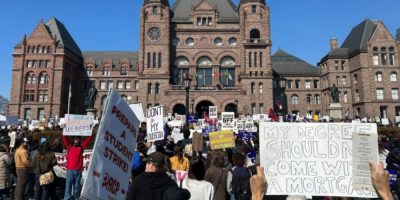
Colleges and Universities Minister Nolan Quinn also announced Thursday that the government will cut back on the amount of financial assistance grants for students, leaning more heavily on loans, which students called a double whammy when combined with higher tuition.
Quinn's announcement of an additional $6.4 billion for the post-secondary sector over four years comes after a funding formula review and a strong push from colleges and universities.
"If we want Ontario to have a competitive workforce tomorrow, we need to strengthen our post-secondary institutions today, and that's exactly what our government is doing," Quinn said.
Barrie's News Delivered To Your Inbox
By submitting this form, you are consenting to receive marketing emails from: Central Ontario Broadcasting, 431 Huronia Rd, Barrie, Ontario, CA, https://www.cobroadcasting.com. You can revoke your consent to receive emails at any time by using the SafeUnsubscribe® link, found at the bottom of every email. Emails are serviced by Constant Contact
Ontario universities and colleges have long faced low levels of government funding, stagnant tuition levels since 2019 and sharply reduced numbers of international students, who are charged far higher tuition fees than domestic students.
Colleges in particular increasingly turned to international student tuition revenue to stabilize finances after the government cut tuition fees by 10 per cent and froze them at that level seven years ago.
An expert report commissioned by the government in 2023 identified that reliance as a major financial risk, and that was borne out when the federal government began drastically reducing international student levels.
Colleges have said that move alone will remove up to $4.2 billion in revenue by 2027-28. Colleges have already cut $1.4 billion in costs, suspended more than 600 programs and eliminated more than 8,000 staff positions in a bid to save money.
Colleges Ontario welcomed the financial relief Thursday's announcement will bring.
"Ontario public college graduates are essential across a wide range of industries, including advanced manufacturing, construction, transportation, mining and energy and health care," said Maureen Adamson, president and CEO of Colleges Ontario.
"College graduates are the boots on the ground. Skilled workers are needed more than ever, and this funding expands regional opportunities for learners and employers alike."
Interim Liberal Leader John Fraser said the government started the fire in the post-secondary sector then didn't offer enough to put it out.
"They starved colleges," he said. "They allowed colleges to rely on foreign students because they didn't have to take the money out of the treasury."
Universities said the new funding and ability to implement "modest" tuition-fee increases will ease the pressures they were facing.
"This new investment strengthens the very foundation our universities provide, greater sustainability and long-term planning to support our students and local communities," said Steve Orsini, president and CEO of the Council of Ontario Universities.
The additional funding includes money for 70,000 more seats for in-demand programs, increased funding for programs that are more expensive for the schools to offer and more per-student funding.
Colleges and universities will be able to raise tuition fees by up to two per cent per year for the next three years. After that period of time, tuition fee increases will be limited to either two per cent or the average inflation rate, whichever is lower.
The government is also decreasing the proportion of grants offered through the Ontario Student Assistance Program, relying much more heavily on loans. The current proportion is about 85 per cent grants to 15 per cent loans, the government said, but starting this fall students will receive a maximum of 25 per cent of their OSAP funding as grants.
The Canadian Federation of Students' Ontario branch said they are glad to see a long-overdue funding boost for institutions, but disappointed it will come with increased tuition fees and higher levels of debt for students.
"Students are already paying their fair share when it comes to education and Ontario students are paying on average $8,000 to $10,000 in tuition fees," said government relations and policy co-ordinator Kayla Weiler.
"The changing of the grant program ... is a huge disadvantage for students. I think what we're going to see is we're going to see a new cohort of students graduating with more student debt than ever before, and this is not fair to students who work really hard."
Demand for OSAP has been rising significantly and the growth was unsustainable, Quinn said.
"This will ensure sustainability and balance for the system," he said. "We want to ensure that all students in future generations have access to OSAP as well."
In line with federal government changes, Quinn announced that students at private career colleges will no longer be eligible for grants through OSAP, only loans.
NDP critic Peggy Sattler said the tuition and OSAP changes will make it harder for young people to start their professional lives on the right foot.
“Young people are already facing record-high unemployment, and are asking whether they can afford rent, groceries, or making a living here in Ontario,” she wrote in a statement.
“Instead of fixing the affordability crisis, this government is telling them to take on more debt and hope things somehow work out."
This report by The Canadian Press was first published Feb. 12, 2026.