
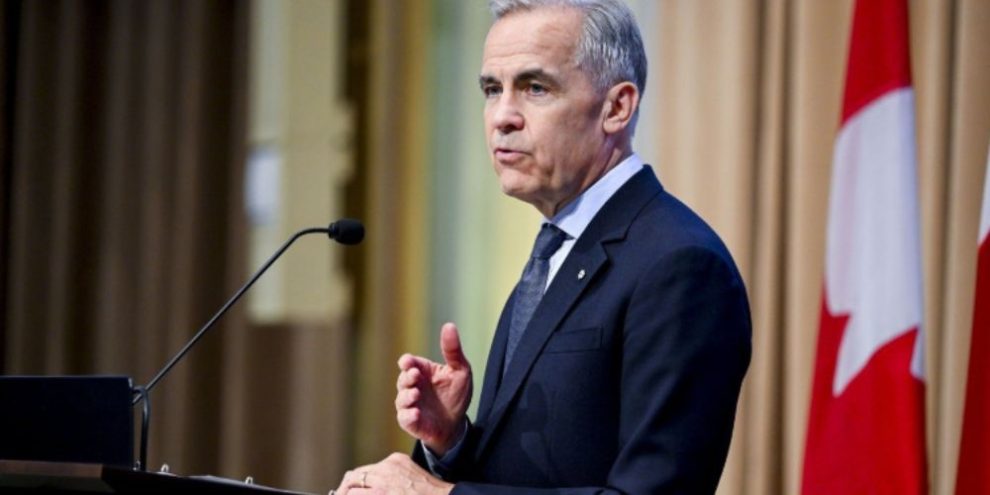
Canada's efforts to diversify trade ties and wean itself off the U.S. market make it a better ally to America, Prime Minister Mark Carney told an audience of business professionals in New York City on Thursday.
Addressing the Economic Club of New York, Carney outlined Canada's economic strategy and the progress made so far. The visit is part of his government's efforts to drum up new international investment.
In his speech, he said Canada is weaving a web of international partnerships that is making it a much stronger, more resilient and more independent country.
He said that's good for Canadians and also for the United States, because it makes Canada a better ally.
"Canada Strong will help make America great again," he said, echoing the slogan Trump has used in past presidential campaigns.
Carney listed several areas where Canada and the U.S. should continue to work together, including the automobile and critical mineral sectors.
"We know that while Canada and the United States have had our differences over the centuries, we have always worked and eventually worked through them, because we share values and our common interests run deep," he said.
Carney pitched the audience on a "new partnership" between Canada and the United States.
"A true partnership that reimagines cooperation in specific sectors that are deeply challenged by global competition," he said. "A partnership with a different Canada, a stronger Canada, a more confident Canada... a country that's predictable, reliable and principled in a world that's anything but."
Carney's office has not yet identified the CEOs, entrepreneurs, business leaders and money managers he's expected to meet with in New York to pitch Canada as an investment destination.
The trip comes as Mexican and American officials assemble this week for negotiations on the Canada-U.S.-Mexico-Agreement on trade, better known as CUSMA.
The United States has not officially launched CUSMA negotiations with Canada.
U.S Trade Representative Jamieson Greer said Tuesday that while there are significant trade issues with Canada, he has been in regular contact with his Canadian counterparts.
The CUSMA review sets up a three-way choice for each country to make in July. They can renew the deal for another 16 years, withdraw from it or signal both non-renewal and non-withdrawal — which would trigger an annual review that could keep negotiations going for up to a decade.
Greer has suggested the Trump administration is unlikely to rubber-stamp a renewal and the three countries are preparing for lengthy trade talks.
U.S. President Donald Trump froze trade negotiations with Canada last year because he was angered by an Ontario-sponsored ad quoting former president Ronald Reagan criticizing tariffs.
While the relationship appeared to thaw in March after a meeting between Greer and Canada-U.S. Trade Minister Dominic LeBlanc, no official negotiations have been launched.
Greer said Tuesday most countries "begrudgingly" accepted that some level of tariffs would remain, but Canada is in a "different spot" and it's "hard to see where that ends." He said tariffs would remain on Canada and Mexico, despite the trade agreement.
As the Trump administration continues to signal a turbulent path forward for the bilateral relationship — it paused the long-standing Permanent Joint Board on Defense earlier this month — Carney has focused on securing investment and deepening Canadian ties with other countries.
On Wednesday, Carney announced the federal government is entering into contract negotiations with Sweden's Saab to buy a fleet of surveillance aircraft for the Royal Canadian Air Force.
This report by The Canadian Press was first published May 28, 2026.