
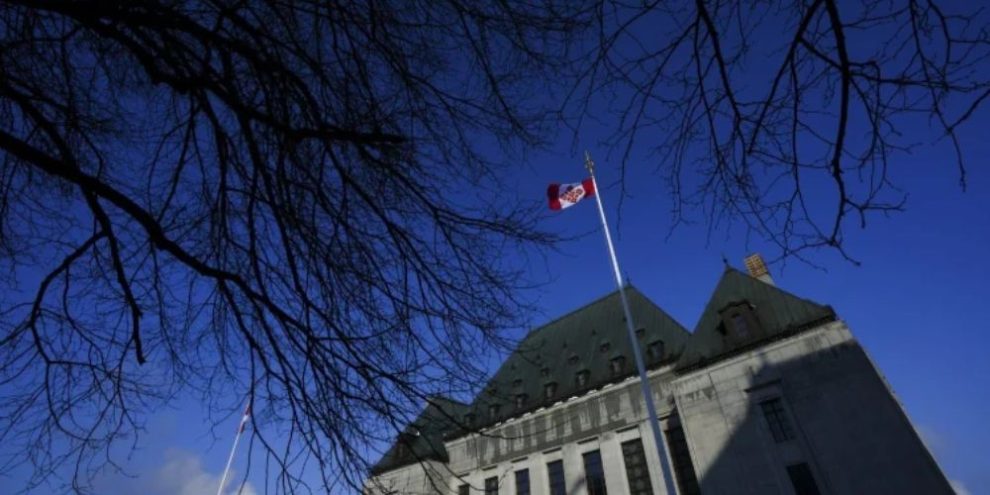
The Supreme Court of Canada has concluded that Quebec did not exceed its powers by banning public servants in positions of authority from wearing religious symbols while on the job.
In a landmark decision, the top court largely upheld most of the Quebec secularism law known as Bill 21, except for a section that banned members of the legislature from wearing religious symbols.
The historic decision provides more clarity on how governments can use a section of the Constitution that allows legislatures to override Charter rights. The justices agreed that governments can use the so-called notwithstanding clause of the Constitution pre-emptively as Quebec did when it introduced Bill 21.
They also said the Constitution allows a legislature to override multiple Charter rights at the same time by pre-emptively using the notwithstanding clause.
"Similarly, a legislative body is not required to show a link or relationship between the law in question and the rights or freedoms it intends to override," wrote Chief Justice Wagner, and Justices Malcolm Rowe and Suzanne Côté in the ruling. "More fundamentally, it is not for the courts to substantively review the legitimacy of the legislative policy pursued by the legislative body or the appropriateness of invoking the notwithstanding clause."
But the court was divided over whether to declare that Bill 21 violated Charter rights, without overturning it.
While the majority did not address whether the law violated rights, three of the seven justices overseeing the Bill 21 case wrote in the ruling that the Quebec secularism law is incompatible with freedom of religion, freedom of expression and the right to equality.
Justices Michelle O’Bonsawin and Andromache Karakatsanis wrote that “there can be no serious question that Bill 21 violates freedom of religion.”
“It treats visible religious minorities as less worthy of full participation in Quebec society, influences their life choices and mobility, and creates professional barriers for them by preventing qualified individuals from being hired, promoted or transferred within public sector workplaces,” they wrote.
They also wrote that Bill 21 is not so incompatible with freedom of religion or human dignity as to be invalid because the notwithstanding clause must be renewed every five years.
Three justices — O’Bonsawin, Karakatsanis and Sheilah L. Martin — declared that the law also violated gender equality, which falls outside the scope of the override clause.
They also determined that the law has a disproportionate effect on Muslim women.
“The attorney general of Quebec chose not to address whether any breaches related to Bill 21 could be justified in a free and democratic society,” they wrote in the judgment.
However, Wagner, Rowe, Côté and Nicholas Kasirer determined that the section protecting gender equality in the Canadian Charter could not be used to strike down Bill 21.
The majority also determined that the override clause prevents the court from ruling on the inconsistency of Bill 21 with Charter rights.
Since the law passed in 2019, Quebec, Ontario, Saskatchewan and Alberta have all invoked the notwithstanding clause pre-emptively to shield some other laws from legal challenges.
These include laws restricting the rights of transgender people in Alberta and Saskatchewan, back-to-work orders in Alberta and Ontario, and Quebec’s language-law reform.
This report by The Canadian Press was first published Nov. 27, 2026.