
Clocks are set to spring forward on Sunday as most of Canada moves to daylight time until the fall.
Daylight time begins at 2 a.m. on Sunday, March 8, when clocks move forward one hour, until November 1, when they'll be turned back an hour to rejoin standard time.
Except in British Columbia, where residents won't be falling back in the autumn. Premier David Eby announced on March 2 that the province will adopt year-round daylight time, starting on Sunday.
The province joins Saskatchewan and Yukon in not observing a time change, although those two maintain permanent standard time, not permanent daylight time.
Barrie's News Delivered To Your Inbox
By submitting this form, you are consenting to receive marketing emails from: Central Ontario Broadcasting, 431 Huronia Rd, Barrie, Ontario, CA, https://www.cobroadcasting.com. You can revoke your consent to receive emails at any time by using the SafeUnsubscribe® link, found at the bottom of every email. Emails are serviced by Constant Contact
Time regulation falls under provincial and territorial jurisdiction, leaving Canada with a bit of a mishmash when it comes to who follows the time-change calendar.
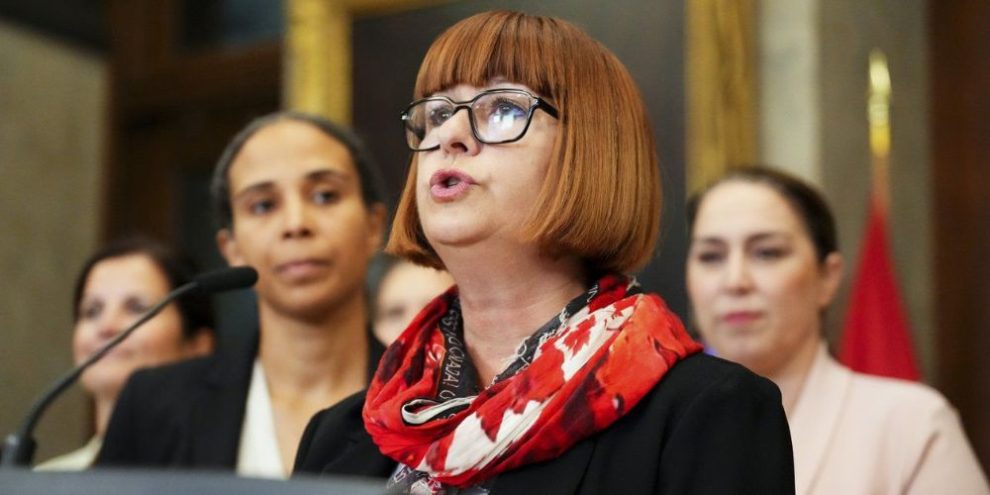
This year's time change also comes as a Liberal member of Parliament is renewing her call for a nationwide halt to the biannual practice of changing the clocks.
MP Marie-France Lalonde introduced a private member's bill last fall to end what she calls the "outdated practice" of daylight time.
The bill calls for a pan-Canadian conference on time changes to look at the economic, productivity and health effects of changing the clocks and the prospect of a more uniform approach across Canada.
The bill went through first reading on Oct. 6 and there has been no movement since on the legislation.
Lalonde told The Canadian Press she has continued to advocate on the issue by sending letters to provincial attorneys general and meeting with representatives of provincial governments.
She said she also has spoken with Intergovernmental Affairs and Internal Trade Minister Dominic LeBlanc about encouraging collaboration with provinces and territories.
Lalonde said B.C.'s decision is "a good step forward."
"My focus has always been to abolish the outdated practice of the biannual time change," she said. "I certainly respect the jurisdiction that each province has and it's within their own rights of choosing which of the two times, daylight saving time or standard time, that they want to choose. That's not for me as a federal member to determine."
The Canadian Encyclopedia says Ottawa officially introduced “daylight saving time” in 1918 as a measure to increase wartime production.
Most provinces and territories observe daylight time. Saskatchewan rarely has and, in 1966, the province passed legislation to make central standard time permanent.
Yukon ditched daylight time in 2020, following a public consultation.
Conversations about dropping the time change have been happening across the country for years.
Lalonde has cited some negative effects of the twice-annual time change, such as health issues and a spike in the number of vehicle accidents. She also said the practice impedes trade between provinces and with U.S. states.
She introduced a bill to drop the time change in Ontario when she was a member of the provincial parliament in 2019. The bill did not make it to a vote.
The following year, the Ontario government passed legislation to end the twice-yearly changing of clocks and make daylight time permanent — but only if Quebec and New York agreed to do the same.
In 2022, Atlantic Canada’s premiers decided to hold off on any move toward dropping the time change until they saw what neighbouring jurisdictions would do.
That sentiment is in line with a change made almost two decades ago to extend daylight time by four weeks. In 2005 United States passed legislation to make the change, effective in 2007. Canadian provinces and territories — except Saskatchewan which didn't observe daylight time at all — then followed suit, thus avoiding complications where U.S. versions of North America's time zones were not the same as Canadian ones.
Lalonde said the time change debate should be a priority.
"It's not just twice a year that we should talk about it. We should talk about in every moment because it has a significant impact disturbing our life and we don't always realize that," said Lalonde.
"Hopefully, this decision from British Columbia will facilitate that pan-Canadian conversation that I believe we should have."
This report by The Canadian Press was first published March 7, 2026.
— With files from Wolfgang Depner