
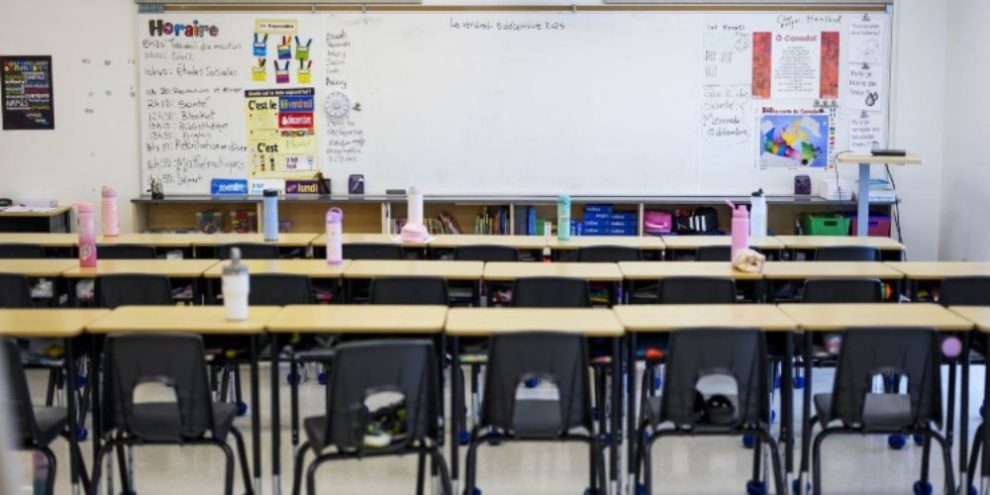
The length of teachers' college in Ontario will soon be cut in half, from two years to one, and have a greater emphasis on practical components as a way to address shortages.
A return to the one-year system Ontario had a decade ago is being welcomed by teachers' groups and principals, though they say it will only address the recruitment side of a teacher supply issue, not retention.
Most programs are currently four semesters and under upcoming legislation, teachers' college across the province would be delivered in three consecutive semesters over 12 months, Colleges and Universities Minister Nolan Quinn announced.
"This change would get future teachers into the classroom faster, jump-starting fulfilling careers and meeting the needs of communities across Ontario," he said at a press conference in Oakville, Ont.
"In addition to a shortened program, under this legislation we would explore new pathways into the teaching profession, because we know there are talented, passionate individuals with relevant experience that would make them a better teacher, and we believe they should be recognized for it, for example, those with early childhood education backgrounds."
Barrie's News Delivered To Your Inbox
By submitting this form, you are consenting to receive marketing emails from: Central Ontario Broadcasting, 431 Huronia Rd, Barrie, Ontario, CA, https://www.cobroadcasting.com. You can revoke your consent to receive emails at any time by using the SafeUnsubscribe® link, found at the bottom of every email. Emails are serviced by Constant Contact
The government will also consult to establish a minimum practicum length as a way to emphasize real, in-class experience.
Ontario currently has among the shortest practicum lengths in Canada for teachers, at 80 days. The Ontario Teachers' Federation has previously urged a consecutive three semesters of teachers' college over 12 months and 100 days of practicum.
Education Minister Paul Calandra said prospective teachers need to be in front of a classroom for a longer period of time.
"We've heard it's just not long enough," he said. "The goal is to make it one of the highest practicums in the country and I think that'll lead to better results for our student teachers."
Calandra said the changes for teachers' college will be included in legislation to be tabled Monday, which will also address school board governance and trustees.
Teachers' college in the province used to be one year, but in 2015 the then-Liberal government made it two years in response to a teacher surplus.
Now, however, the province is grappling with a shortage, which internal ministry documents have in recent years said could get worse in 2027. Shortages of French and technological education teachers are particularly acute.
Martha Hradowy, president of the Ontario Secondary School Teachers' Federation, said teacher working conditions and class sizes must improve if the province hopes to actually retain all the new teachers it graduates.
"I believe that this is a step in the right direction, but it only opens the front door, and right now, teachers are walking out the back," she said.
Shirley Bell, first vice-president of the Elementary Teachers' Federation of Ontario, said to help on the retention side, the province must also put more supports in schools in the form of educational assistants, social workers and psychologists, to name a few.
"That will help address the needs of our students because that’s what this is about," Bell said.
"What we need is for our professionals — our teachers and our educators — to get the support in their classrooms to support student learning. When we can do that, then we can address the complexities of what’s happening in the classroom and that's how we can retain more teachers in the profession."
The Ontario Teachers' Federation has estimated that there are about 48,000 teachers who are certified but not currently working in the province's education system.
Jeff Maharaj, president of the Ontario Principals' Council, said he is hopeful the announcement will make a difference, but more still needs to be done.
"Do I think it’s going to fix the recruitment and retention issues?" he said. "I think it will help. I don’t think it’s a one-stop solution."
Universities that offer teacher education stand to lose out as students attend for one fewer semester. Steve Orsini, president and CEO of the Council of Ontario Universities, said in a statement that universities recognize the importance of getting teachers into the classroom in a timely and affordable manner.
"Continued collaboration with the sector will be essential to address financial impacts, ensuring that teacher education programs are positioned to deliver the high-quality preparation that leads to excellent teachers in Ontario’s classrooms," he wrote.
The province in last year's budget put about $56 million toward faculties of education to train 2,600 new teachers by 2027. As well, Quinn said that a recent announcement of $6.4 billion for colleges and universities included $150 million for teacher education programs.
Friday's announcement also includes $16.8 million to increase the honorarium for associate teachers, who supervise student teachers during practicum placements.
This report by The Canadian Press was first published April 10, 2026.