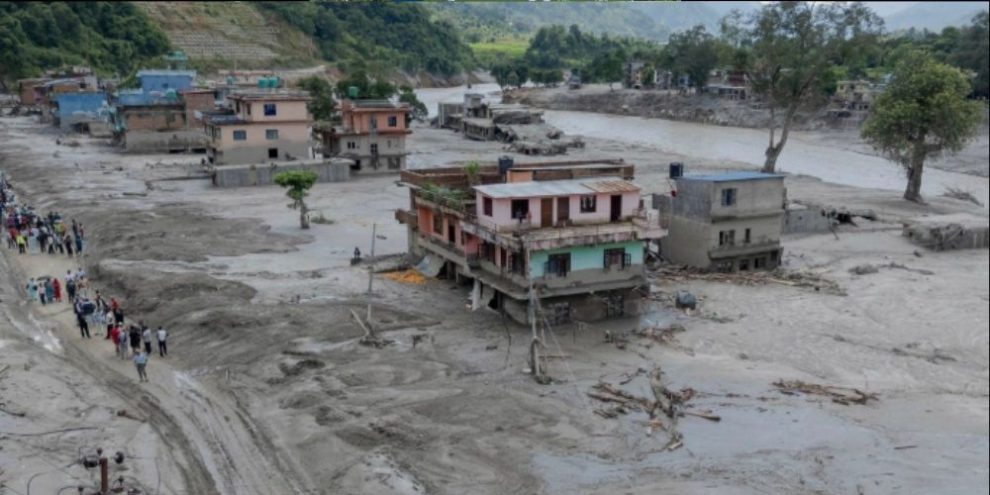
Rescue crews in Nepal are racing to reach survivors buried under mud and stranded in remote mountain areas after catastrophic flooding along the Nepal-China border killed hundreds and left more than 1,500 people missing.
The disaster is also reverberating far beyond the Himalayas. Among those still unaccounted for are hundreds of foreign nationals who were in the region for work, trekking expeditions or religious pilgrimages. Nepal's tourism board says more than 500 foreigners are missing, leaving families around the world anxiously waiting for news.
Authorities on both sides of the border are now confronting a new concern: a lake formed after the glacier collapse that triggered the disaster is beginning to overflow, raising fears of additional flooding.
The floods have killed 538 people in Nepal, according to the country's disaster management authority. Nepali police later put the death toll at 547. In China, state media reported the death toll rose to five on Friday.
More than 3,700 people have been rescued in Nepal, while 977 remain unaccounted for, including 30 Canadians. Chinese state media previously reported 558 people missing on the Chinese side.
Authorities warn of another flooding threat
Emergency officials in Nepal issued a fresh alert Friday after receiving information that a dam on the Tibet side had burst.
Security personnel and rescue workers were instructed to remain on high alert and move to safety immediately if conditions worsened.
It remains unclear whether the reported dam failure is connected to concerns about a newly formed barrier lake created after Wednesday's flash floods.
Chinese state broadcaster CCTV reported the lake is located more than 10 kilometres from Gyirong Port, the heavily damaged border crossing with Nepal. The lake sits at an elevation of 2,950 metres.
Officials in both countries had already warned that the lake was overflowing and could release additional torrents of water and debris downstream.
Rescue teams heading into the disaster zone temporarily halted operations Friday morning because of those concerns. Residents in vulnerable areas were urged to move to higher ground.
Despite the risks, about 680 rescuers eventually reached the hardest-hit area around Gyirong on foot and by raft. CCTV footage showed some personnel being lowered into the area by drone.
Nepali police spokesperson Abi Narayan Kafle said rescue efforts were continuing.
"It hasn’t stopped," he said.
More than 100 people believed trapped in hydropower tunnel
In Nepal's Rasuwa district, army rescuers are working to reach more than 100 people believed trapped inside a tunnel connected to the Upper Trishuli-1 Hydropower Project.
The military said 350 people have already been rescued from the tunnel.
Video from the scene showed emergency crews pulling and pushing a man coated in thick brown mud to safety.
Army spokesperson Brig. Gen. Raja Ram Basnet said challenging conditions continue to hamper the operation.
"It is complicated to find the entry and exit points of the tunnel because everything has been covered by mud," Basnet said. "Our first priority is rescuing the stranded people."
Nepal's disaster management authority said 3,253 people have been airlifted out of the disaster area by helicopter and transported to Kathmandu and other locations.
Scientists trace disaster to glacier collapse
Researchers studying satellite imagery say bedrock beneath a glacier high in the Himalayas collapsed, bringing part of the glacier down with it.
The rockfall was so significant it registered a magnitude 5.2 seismic event.
Rock, ice and meltwater then surged into rivers below, sending a destructive wall of water through valleys in Tibet and Nepal. Buildings, bridges and large amounts of earth were swept downstream.
Customs officer Karbir Gaire survived the disaster in Timure, the Nepalese village closest to the Chinese border, where about 1,500 people had lived.
Gaire had arrived at work around 8 a.m. Wednesday and was sitting at his computer when he felt the ground shake.
"Right after the shake, I noticed a black storm coming towards us," he recalled from Kathmandu, where he is back with family. "We all immediately started running out, and within a few seconds, we were climbing uphill on the opposite side of our office building. I think those 10 or so seconds saved some of us."
Fifteen of his colleagues remain missing.
"It was like a Hollywood movie scene. I don’t call it a flood, it was a tsunami."