Security guards searching bags before bar mitzvahs.
Students who hide their Star of David necklaces for fear of being attacked.
Synagogue services that start with staff pointing out where the emergency exits are.
In the three years since Hamas unleashed a deadly terrorist attack on Israel, and Israel responded with a relentless war it says is aimed at eliminating Hamas in Gaza, life for Jewish Canadians has changed dramatically.
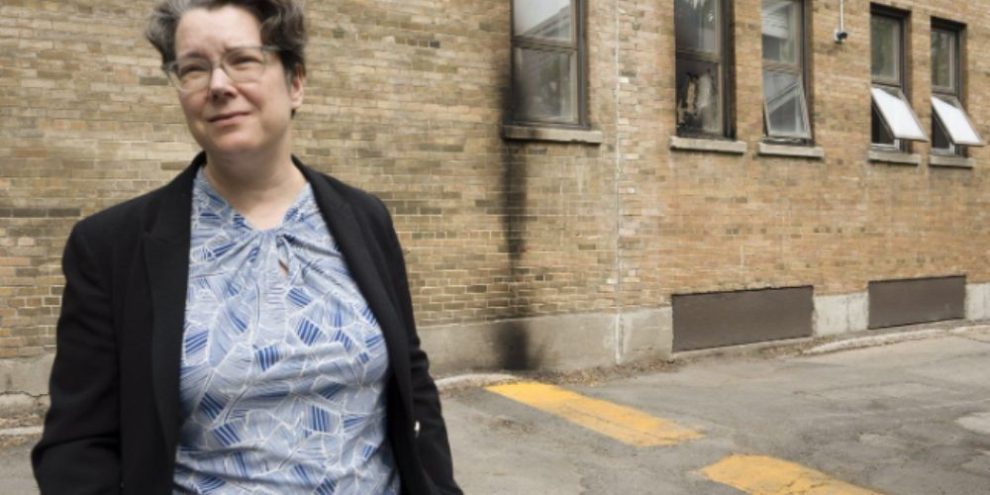
"The society we're living in is not quite the society we thought," said Lisa Grushcow, senior rabbi of Temple Emanu-El-Beth Sholom in Montreal. "There's this feeling of a world that's really been turned upside down."
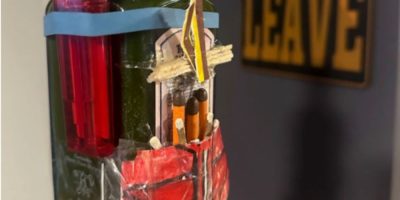
Canadian Jews are facing a spike in antisemitic attacks — firebombings at synagogues like Grushcow's, shootings at Jewish schools and physical assaults which police have classified as hate crimes.
The Canadian Security Intelligence Service mentioned in its annual report for 2025 a number of disrupted plots targeting Canadian Jewish institutions, and cited the arrest in August 2025 of a Montreal youth who intended to target Jews.
It said religiously motivated violent extremism has "increased significantly since the beginning of the Israel-Hamas conflict," has driven "violent extremist organization narratives" and "has the potential to inspire a new generation of extremists."
Since 2023, Jewish communities have been the most frequently targeted group in police-reported hate crimes, despite representing less than one per cent of Canada's population.
Toronto's police service said in September it had made 573 arrests and laid 1,398 charges in connection with demonstrations, protests and hate-motivated offences targeting Jewish communities since Oct. 7, 2023.
The Ottawa Police Service Board report issued last week said "Jewish residents have reported fear about wearing a kippah, Star of David or other visible expressions of Jewish identity in public."
"Community organizations have adopted heightened security measures for religious, cultural and commemorative gatherings — including advance registration, identification requirements, restrictions on attendance and, in some circumstances, limiting public disclosure of event details," the report said.
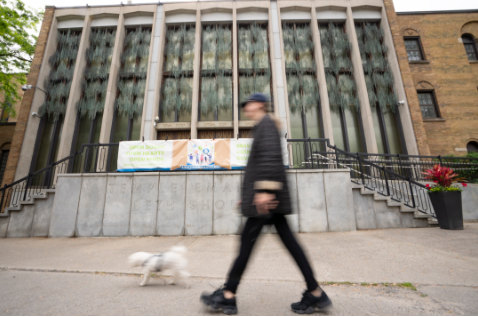
Grushcow's synagogue, which was founded in 1882 and incorporated one year later, represents one of the most progressive branches of Judaism. In June, someone attacked the temple with a firebomb. In February 2025, a swastika was spray-painted on the building's exterior.
"There's been a lot that's become normalized over the past three years that I think is just deeply disturbing — for us as a community, but also for us as a society," Grushcow said.
She said she encourages non-Jewish Canadians to ask a Jewish friend if they can attend a synagogue. What they would find, she said, is communities grappling with the need to protect themselves without making those attending services feel too afraid to show up.
Jeff Lieberman, president of the Jewish Federation of Winnipeg, said Jews feel displaying menorahs and mezuzahs — a door frame case containing Torah scrolls — makes them targets for hate crimes.
He said Jews in Winnipeg are alarmed by the number of hate messages graffitied around their city.
"It brings back to days of the 1930s when Jews were persecuted. And the feeling of what's happening now is the lead-up to something like that," he said.
Lieberman said many Jews are particularly upset that Ottawa has promised to study the drivers of antisemitism when the causes are widely documented. He said the government could be doing more.
"The Canadian government may not support the government in Israel, but that has nothing to do with Jews in Canada. They need to be able to support Jews," he said.
Lieberman said the fear is compounded by reports of attacks in smaller communities that lead some to wonder if anywhere in Canada is truly safe.
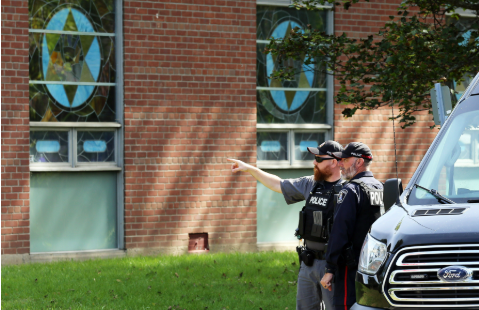
Last month, a gunman shot at a Belleville, Ont., synagogue and a police officer who was guarding the building was shot and critically wounded. Days later, the neighbourhood where the synagogue is located was targeted by someone distributing antisemitic flyers.
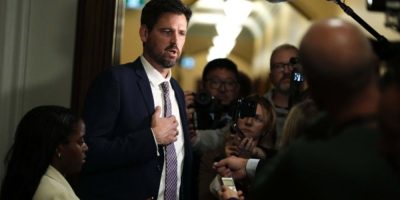
Conservative deputy leader Melissa Lantsman said the shooting incident added to the existing climate of fear and shock.
"The next day, our synagogue, as it often does, starts with a security briefing of what to do when things go south, on where the doors are," she told reporters on Parliament Hill on Sept. 24.
Grushcow said there are immediate safety concerns for Jewish communities, along with longer-term questions about how to restore civic dialogue.
"I was at the Pride march last summer. Somebody looks at me and sees me with a rainbow Star of David on my shirt and calls me a baby killer. What is that? How has that become our new normal?" she said.
"How is it that any connection or care for Israel — which is the reality for the vast majority of Canadian Jews, for all kinds of historical, religious, spiritual reasons — how does that become something … that becomes perceived as a reason to keep people out of academic and professional and personal relationships?"
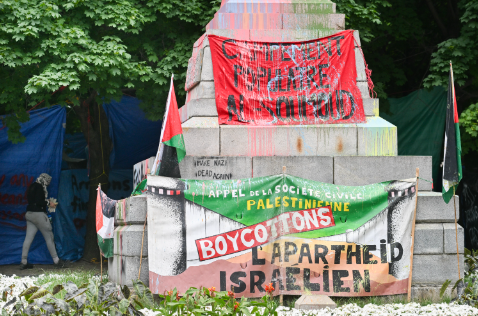
At the centre of some of the concern is the wave of anti-Israel protests that erupted after Oct. 7.
Some of the groups behind those protests say they are targeting organizations that actively support the Israeli military — such as a business fundraising for foreigners who serve in the Israeli Defense Force, or a synagogue that appeared to be promoting the sale of land in the occupied West Bank.
Independent Jewish Voices has argued antisemitism is being weaponized to suppress pro-Palestinian advocacy.
But many Canadian Jews feel they're being targeted for being Jewish, regardless of whether they support the Israeli government.
Grushcow said Canadians need to find a way to balance open dialogue with respect and safety.
She said Canadian society has "become very quick to write people off" over their perceived loyalties and is losing the ability to maintain "dialogue across difference."
Grushcow is among many Jewish leaders who question whether Iran has played a role in inflaming tensions in Canada. She said it's hard to imagine who benefits from Jews being threatened and Canadian society losing its civility.
In June, Ruby Sahota, the secretary of state for combating crime, told the House of Commons that people who fired shots recently at synagogues were hired and paid by a "foreign entity."
Ottawa has boosted funding for security at synagogues and expanded hate-speech laws. Grushcow said Canadians need to do more.
"We have to stop saying this isn't who we are and recognize that it's who we've become, and then how do we change that," she said. "That work can't come entirely from the Jewish community."
This report by The Canadian Press was first published Oct. 7, 2026.