
Updated January 28, 2026 @ 3:07pm
If it felt like the earth moved beneath your feet late Tuesday night, it did, if you were in Central/Southern Ontario.
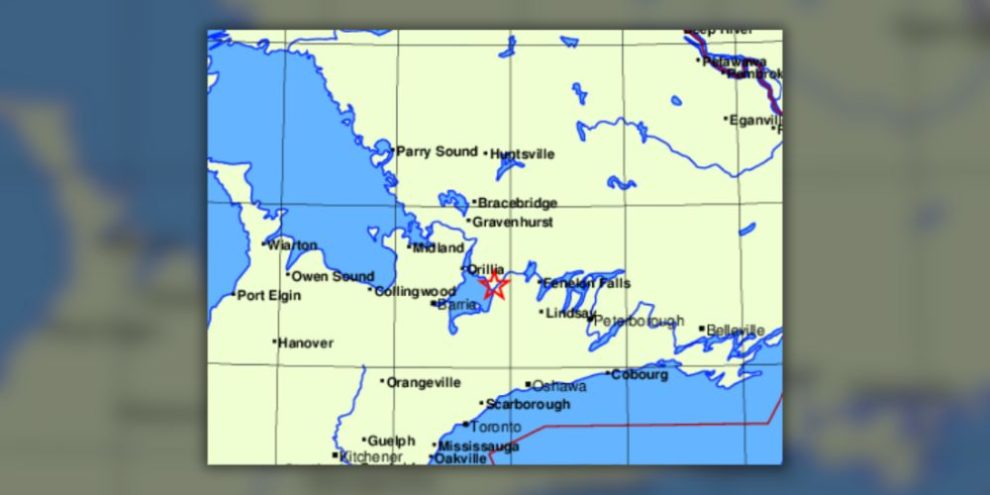
Earthquakes Canada recorded a magnitude 3.7 quake just before 11:00 p.m. Eastern Time.
The agency noted the tremor was centred near Brechin, southeast of Orillia, and occurred at a depth of five kilometres.
Barrie's News Delivered To Your Inbox
By submitting this form, you are consenting to receive marketing emails from: Central Ontario Broadcasting, 431 Huronia Rd, Barrie, Ontario, CA, https://www.cobroadcasting.com. You can revoke your consent to receive emails at any time by using the SafeUnsubscribe® link, found at the bottom of every email. Emails are serviced by Constant Contact
Mareike Adams, a seismologist with Natural Resources Canada, told Barrie 360 that an earthquake like the one on Tuesday night is an unusual event for the region.
"This region is what we call the Southern Great Lakes seismic zone, and it has a relatively low level of seismicity compared to a lot of regions in Canada. There have not been very many large events in this region, and the one that happened last night was one of the largest we've had in the region."
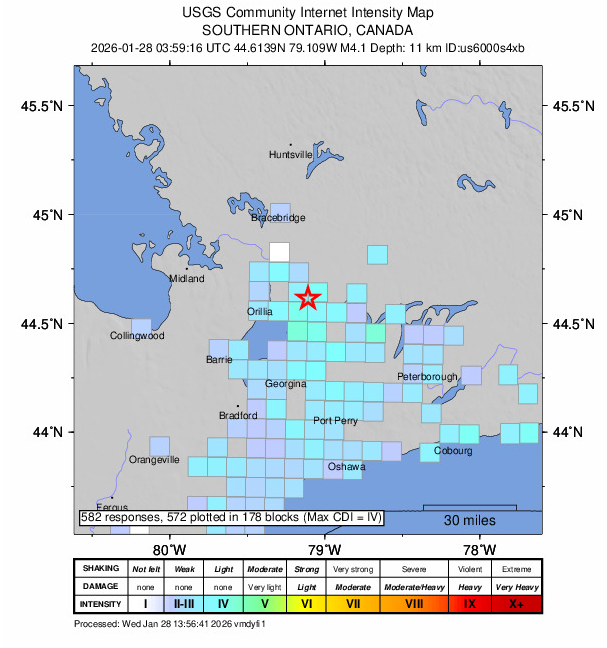
Adams said the Earthquakes Canada website had at least 2,700 reports and counting from people who felt the rumbling.
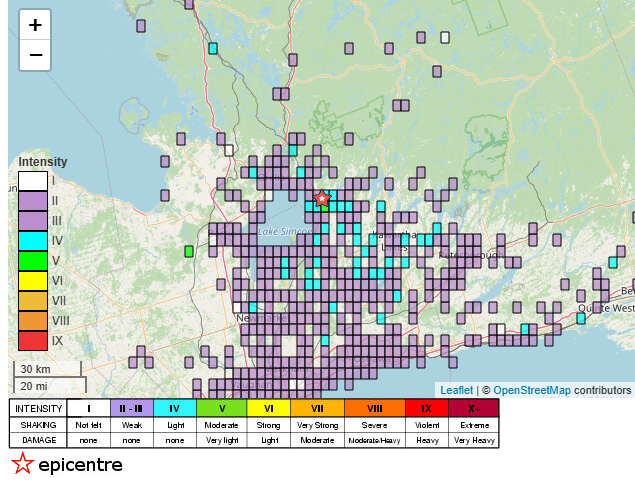
"People were describing feeling a kind of low rumble, and that's often what we feel or how we describe these kinds of size earthquakes, since it's still relatively small in the grand scheme of things. It usually feels kind of like a really large truck rumbles past."
Adams said they have received reports from as far east as Kingston, all over Toronto, west to London, and in St. Catharines, Hamilton and Kitchener.
No injuries or damage have been reported.
"We don't usually see damage until about a magnitude 5," Adams said. "We are quite below that threshold."
She said the Southern Great Lakes seismic zone has had earthquakes of similar size to the one near Orillia, including rumbles in Owen Sound and Port Hope, and there was a magnitude 5 in Attica, New York in the 1920s.
What would trigger such an earthquake in our region is a bit of a mystery to scientists.
"Eastern Canada is part of the stable interior of the North American plate, so these earthquakes don't have an exact known cause because we can't see these faults," Adams explained. "What we do see is a lot of these earthquakes in eastern Canada are related to a kind of regional stress field and are concentrated in areas of crustal weakness or a really old fault that occurred and has been buried over a period of time, and those might be activated and you could get some of these earthquakes."
Social media was abuzz with people commenting that the quake was just the latest challenge for the region, which has recently experienced extreme snow and cold.
with files from The Canadian Press