Updated February 10, 2026 @ 3:21pm
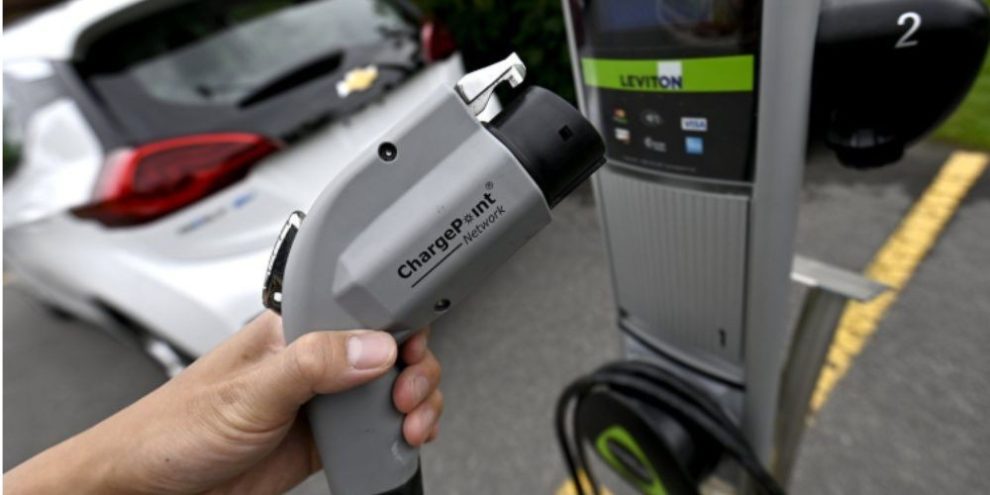
The federal government is looking to increase the number of electric vehicle chargers across the country through its new automotive strategy — but is still well short of the number it was told it needs to support the transition to battery-powered cars.
Energy Minister Tim Hodson said Tuesday the government is planning to spend more than $84.4 million to add 8,000 electric vehicle charging ports to Canada's existing stock of more than 30,000.
The announcement did not cite a timeline for getting the charging ports in place. It's also not clear whether Ottawa will be footing the entire cost of the 122 projects to build more chargers, or just a portion of it.
Hodgson held a news conference on Parliament Hill alongside Environment Minister Julie Dabrusin and Transport Minister Steve MacKinnon, but the ministers took only a few questions from reporters.
Hodgson's office said he wasn't available to answer more questions about the plan later in the day.
"Many Canadians want to choose cleaner options, but they feel like EVs are too expensive, or they worry about not having enough charge to get where they need to go," Hodgson said in his opening remarks.
Tuesday's announcement committed $7.2 million to 30 public awareness campaigns related to EVs, and $5.7 million to three projects to help Canadian freight companies purchase low-carbon vehicles.
Joanna Kyriazis, director of policy and strategy at Clean Energy Canada, called Tuesday's announcement "great news."
"It's excellent to see the federal government continue the momentum that was created last week with the auto strategy. It's like doubling down on Canada's EV future," Kyriazis told The Canadian Press.
Barrie's News Delivered To Your Inbox
By submitting this form, you are consenting to receive marketing emails from: Central Ontario Broadcasting, 431 Huronia Rd, Barrie, Ontario, CA, https://www.cobroadcasting.com. You can revoke your consent to receive emails at any time by using the SafeUnsubscribe® link, found at the bottom of every email. Emails are serviced by Constant Contact
"Access to public charging is an important part of the equation in supporting this transition to EVs and ensuring we've got a robust market here for EVs in Canada to help support the industry that we're trying to grow."
In a 2021 analysis commissioned by Natural Resources Canada, Montreal-based consultancy Dunsky Energy and Climate estimated Canada would need 52,000 chargers by the end of 2025, and 447,000 by 2035.
Natural Resources Canada data shows there are more than 38,000 public chargers now, in almost 14,500 different locations across the country.
The rollout of EV charging ports slowed last year, when only 6,170 ports were built — down from more than 7,000 in both 2024 and 2023.
Kyriazis said the slower rollout of charging stations last year was due in part to market uncertainty caused when Ottawa announced a pause of its electric vehicles sales mandate.
"We had no idea what direction the government was going to take when it came to EVs. We looked at what was going on in the U.S., where there is a major backtrack on all EV-related policies and programs, and I think the sector got spooked," she said.
"But now that we've got a clear signal back from the federal government that Canada is all-in on EVs, and as soon as we have that regulatory path in place, then I expect we'll see a quick uptick in charging investments again."
Most of Canada's charging infrastructure is concentrated in Ontario and Quebec, which together account for 67 per cent of all charging ports across the country.
B.C. has another 20 per cent share, while Alberta is home to 5 per cent of all charging ports.
Prime Minister Mark Carney said last week Ottawa would spend $1.5 billion on EV infrastructure as part of a suite of changes to the federal auto strategy.
That announcement included the return of an EV rebate program offering Canadians up to $5,000 toward the cost of an eligible fully electric vehicle and $2,500 toward plug-in hybrids, with diminishing rebates every year until 2030.
Carney also announced the end of the EV sales mandate in favour of stricter emissions standards for the auto sector.
This report by The Canadian Press was first published Feb. 10, 2026.