
Statistics Canada reported an easing in the headline inflation rate Tuesday but a jump in the pace of food inflation amid tax changes and lingering pressures at the grocery store continue to put the squeeze on consumers.
StatCan said Tuesday that the annual rate of inflation edged down to 2.3 per cent in January. Economists had expected inflation to hold steady at 2.4 per cent.
The agency said gas prices were 16.7 per cent lower year-over-year in January, largely thanks to the end of the consumer carbon price in April. Shelter inflation — long a pain for households in Canada — also fell to its lowest level in nearly five years as rent pressures abate.
Those declines helped offset food inflation, which accelerated to 7.3 per cent annually in January from 6.2 per cent a month earlier.
TD senior economist Leslie Preston said that part of the food inflation increase is a statistical phenomenon, while other factors tied to past inflationary pressures are still working their way through the supply chain.
StatCan said a jump of 12.3 per cent in the cost of restaurant meals year-over-year drove the acceleration in food inflation last month.
That surge was mostly tied to the federal government’s “tax holiday” — a two-month break on the federal portion of sales tax on qualifying goods and services — taking full effect a year earlier.
January 2025 marked the only full month of Ottawa’s temporary tax reprieve on dining out and a variety of goods and services and annual comparisons are somewhat distorted as that tax is added back into the inflation calculations for January 2026.
Prices for alcohol, children’s clothes, toys and games also jumped year-over-year due to the “tax holiday” effect.
With February marking the final partial month for the temporary tax break in 2025, Preston said those factors will start to unwind from the inflation calculations.
Food inflation has been a hot topic on Parliament Hill.
Conservative Leader Pierre Poilievre posted on social media Tuesday pinning the blame for rising food prices on regulatory fees driving prices up across the supply chain. He wrote a letter to Prime Minister Mark Carney "demanding emergency reversals on Liberal policies before Canadians go hungry."
Costs for food from the grocery store rose 4.8 per cent annually in January, slowing from a price hike of five per cent in December. StatCan said prices for fresh fruit fell 3.1 per cent in the month as stable growing seasons in producer regions eased prices for berries, oranges and melons.
But prices for household staples like coffee and beef are still facing double-digit increases — and Preston said that's not a "tax holiday" effect.
She said much of today's higher prices are related to the weaker Canadian dollar in early 2025 as well as Canada's retaliatory tariffs on the United States, which targeted grocery products such as Florida orange juice. Both of those factors make it more expensive for importers to buy food or ingredients from outside the country.
While the Canadian dollar has recovered somewhat and Ottawa dropped the bulk of its U.S. counter-tariffs in September, Preston said impacts on the grocery supply chain tend to hit consumers with a lag.
An analysis from Bank of Canada senior economist Olga Bilyk released earlier this month showed a tight correlation between food inflation and increased supply chain costs after accounting for a six-month delay.
That means relief from the end of those cost pressures will also take time to show up on Canadians' grocery bills.
Barrie's News Delivered To Your Inbox
By submitting this form, you are consenting to receive marketing emails from: Central Ontario Broadcasting, 431 Huronia Rd, Barrie, Ontario, CA, https://www.cobroadcasting.com. You can revoke your consent to receive emails at any time by using the SafeUnsubscribe® link, found at the bottom of every email. Emails are serviced by Constant Contact
"These things take time to show up at the retail level so we expect to increasingly see cooler grocery inflation over the year ahead," Preston said.
Some of the factors affecting grocery store inflation in Canada are global, such as droughts from years' past leading to smaller cattle herds and tougher growing conditions for coffee beans, Preston noted.
But even as commodity prices put pressure on grocery shelves across the world, in the United States, food prices rose 2.9 per cent in January.
Preston said that Canada tends to get hit harder than the United States — particularly in the winter months — because less fresh food is grown north of the border. That leaves Canada more vulnerable to import price impacts and currency fluctuations.
Bilyk, in her analysis, also pinned much of the blame for recent food inflation on rising import costs. Foods like coffee and chocolate are facing higher prices globally due to extreme weather and trade tariffs, she said.
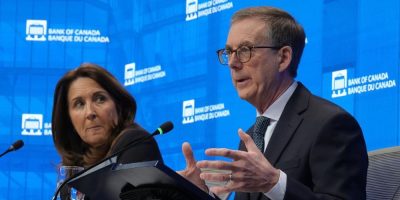
StatCan’s January price report marks the Bank of Canada’s first look at inflation data since the central bank held its benchmark interest rate steady at 2.25 per cent last month.
Preston said that, overall, the data is showing that prices across the household basket are easing at a somewhat faster pace than TD expected.
She said the Bank of Canada would need to see a few more months in a row of inflation slowing at this pace if it were to consider any additional interest rate cuts.
"We'll be watching closely over the next couple of months to see if this trend continues, but, if it does, we would expect the Bank of Canada to shift towards a bias towards cutting interest rates," Preston said.
Financial market odds of an interest rate cut at the Bank of Canada's next decision on March 18 stood at just over 10 per cent as of Tuesday afternoon, according to LSEG Data & Analytics.
BMO chief economist Doug Porter said in a note to clients Tuesday that progress on the central bank's preferred core inflation metrics in January will be encouraging.
He said the bar for another rate cut is high as central bank officials warn there is little more monetary policy can do to support the economy through its trade-driven structural transition.
Porter also argued an eventual cut isn't completely off the table.
"Even so, if inflation continues to decelerate, the bank could be in position to support the economy should growth truly struggle as it undergoes a structural shift," he said.
The Bank of Canada will get another look at inflation dynamics for February before its next decision in March.
This report by The Canadian Press was first published Feb. 17, 2026.