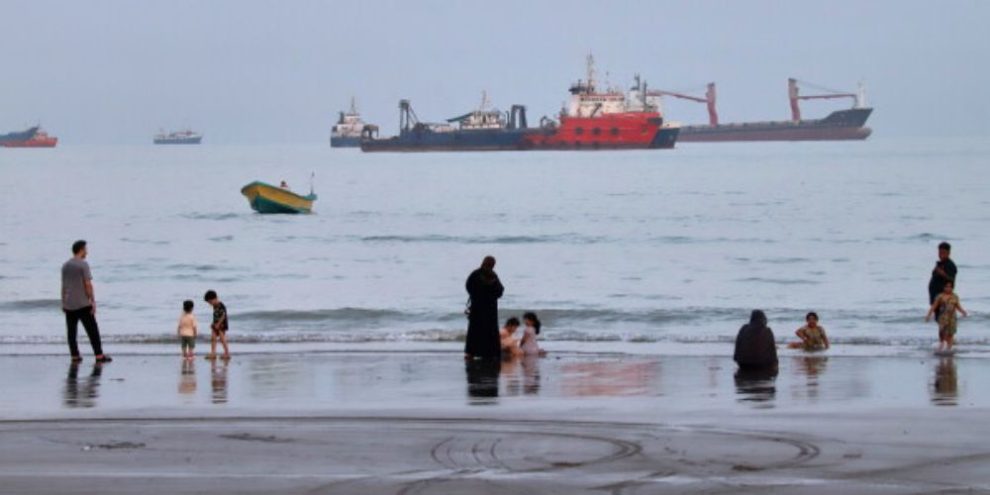
Iran's leadership believes a prolonged standoff with the United States could ultimately secure something it has long sought: greater control over the Strait of Hormuz, one of the world's most important energy shipping routes.
The narrow waterway, through which roughly a fifth of the world's traded oil and gas previously moved before the war, has become a key point of leverage for Tehran as negotiations and military tensions continue.
Iranian officials and analysts argue that mounting economic and political pressure on the United States gives Tehran an advantage. Their calculation is based on several factors, including dwindling U.S. supplies of advanced missile interceptors, the unpopularity of the war among Americans, rising energy costs and the challenges involved in reopening the strait through military force.
Iran also believes its Houthi allies in Yemen retain the ability to broaden the conflict and disrupt other critical trade routes.
But the strategy carries significant risks for Tehran as its own economy struggles under sanctions, military strikes and domestic unrest.
A possible deal could reshape control of the waterway
Iran says it is close to reaching an agreement with Oman over management of the Strait of Hormuz, which lies between the two countries.
However, Tehran said Saturday that the passage will remain closed until the U.S. "corrects its behaviour." Iranian officials insist Washington must permanently end the war, lift its naval blockade of Iranian ports, withdraw military forces from the region, compensate Iran for war damage, remove sanctions and "unconditionally" release frozen assets.
The White House has not publicly commented on the proposal.
Any agreement with Oman could formalize Iran's control over a waterway that had long been considered open international waters before the conflict erupted.
Abdolreza Davari, an analyst who once advised former President Mahmoud Ahmadinejad, said Iran sees its effective control of the strait as a major source of influence.
“More than revenue from the strait, Iran wants to confirm its management and sovereignty over the strait,” he said by phone from Tehran.
Such an outcome would represent a significant strategic victory for Iran while dealing a setback to the United States, whose goals in the conflict have shifted over time.
It could also challenge long-standing international principles regarding freedom of navigation and establish a precedent that some countries fear could encourage nations to restrict major trade chokepoints.
China, which purchases Iranian oil and maintains influence in Tehran, said as recently as May that "normal and safe passage" through the strait should be restored.
Tehran believes the balance is shifting
Iranian officials increasingly argue that momentum is moving in their favour.
Borrowing language often associated with U.S. President Donald Trump's own approach to negotiations, Tehran believes it now holds considerable leverage.
“They started the war, but its end was never with them. We always decide for ourselves when it ends,” Mahdi Mohammadi, an adviser to Iran’s chief negotiator, posted on social media. “Iran is going after the enemy’s defeat - not an agreement.”
Mohammadi said a surprise Iranian attack on Jordan in July helped offset falling oil prices. The incident contributed to the collapse of an interim agreement reached in June that offered significant concessions to Iran, including a U.S. waiver allowing international oil sales and promises of broader sanctions relief.
Iran has repeatedly stated that the Strait of Hormuz will not return to its previous status as an open waterway. It has also warned that it will continue targeting ships attempting to pass through without permission.
Iran's joint military command has described the issue as an "unbreakable red line."
“For Iran, the Strait of Hormuz has become a strategic lever for deterrence, maintaining the regional balance of power, and reshaping the security rules in the Persian Gulf,” said Mostafa Najafi, a Tehran-based security analyst.
The dispute over the strait has also overshadowed concerns about Iran's nuclear program, which remains unresolved.
“The atomic issue, because of the conflict in the Strait of Hormuz, has been pushed to the side, and in reality, that is in Iran’s interests,” said Rahman Ghahremanpour, an Iran-based analyst.
He said control of the waterway could strengthen Iran's position if nuclear negotiations resume.
Economic pressure remains a major threat
Despite projecting confidence, Iran faces mounting economic challenges.
The broader impact of the war has rippled across the global economy, but has been especially severe inside Iran. U.S. and Israeli strikes have heavily damaged industrial facilities, while the U.S. blockade has sharply reduced oil exports.
At the same time, Iranians are dealing with triple-digit food inflation and repeated warnings from Trump about possible attacks on civilian infrastructure, including water and electricity systems.
Domestic tensions have already surfaced.
A currency crisis in December triggered some of the largest anti-government demonstrations since the Islamic Republic was established 47 years ago. Authorities responded with a crackdown that reportedly left thousands dead and tens of thousands detained.
Some Iranian political figures worry the government could be overplaying its hand.
Mohammad Javad Zarif, the former foreign minister who helped negotiate the 2015 nuclear agreement, recently argued that Iran's wartime gains have created "an exceptional window for diplomacy."
However, he also warned that failure to reach an agreement carries serious risks.
"Economic recovery will be difficult, and the possibility of internal unrest or renewed aggression, especially after the U.S. elections, cannot be ruled out."
An uncertain path forward
The conflict has confounded expectations on both sides.
After the first wave of U.S. and Israeli strikes on Feb. 28 killed Iran's supreme leader and other senior officials, Trump suggested the war could end within weeks.
Instead, the confrontation has persisted and, in some respects, strengthened support for Iran's leadership among its backers.
According to Ghahremanpour, Tehran is using control of the strait largely to demonstrate resilience.
"It can increase its legitimacy at home."
Still, he cautioned that the strategy has limits. Continued economic deterioration could trigger fresh unrest and eventually force Tehran back to the negotiating table.
“Iran cannot continue with this strategy forever, and at a certain point, in reality, it has to reach a deal with America,” he said.
Davari, however, believes Iran is prepared to endure further hardship.
“It’s unlikely, despite the difficulties of the economic situation, that Iran will retreat from its positions,” he said.