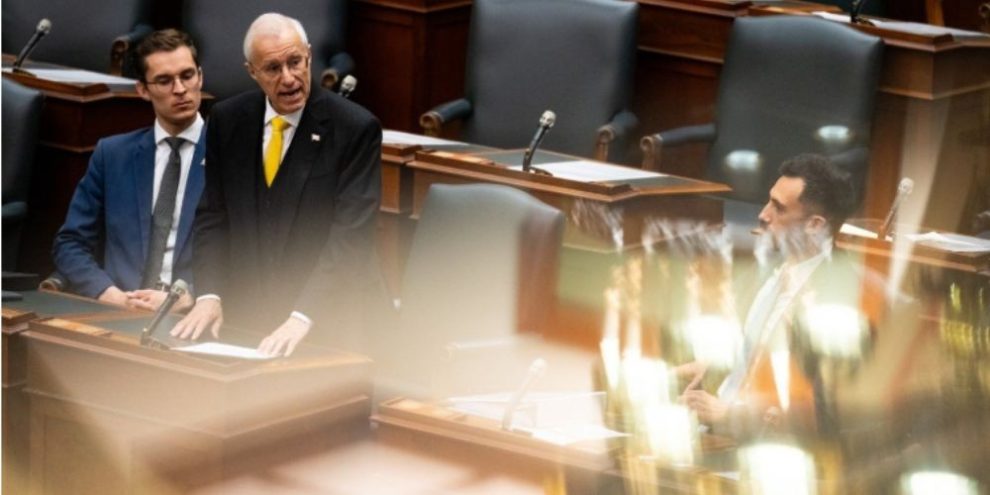
In a year that began with the United States upending global trading relationships, Ontario's economic development minister travelled the world in search of new ties and has zeroed in on the defence sector as a way to steady the ship into next year and beyond.
The American-generated turmoil is far from over but Ontario, like the country, and like most of the rest of the world, is looking to distance itself from the seemingly daily onslaught, Vic Fedeli said in a recent interview.
"The theme around the world is, how can we work together around the U.S.?" he said. "They know you wake up every morning sort of with one eye half-cocked, looking at Twitter and wondering, 'What new hell have we been delivered this morning?'"
Fedeli — formally known as the minister of economic development, job creation and trade, but informally dubbed Ontario's chief salesperson — flew to 20 countries this year seeking to strengthen ties and forge new ones.
Next year will bring more of the same, though perhaps "dialed back a hair," he said.
"Twenty countries was a lot," Fedeli said. "We've got to let some of that mature now and close these deals that we believe are all now pending, so we want to make sure that we close them. But you'll really see us more focused on the places that we go to, focused on defence."
Fedeli is looking to secure new production in the province from foreign companies and help open new markets for existing Ontario defence manufacturers, but he also aims to boost domestic production.
Barrie's News Delivered To Your Inbox
By submitting this form, you are consenting to receive marketing emails from: Central Ontario Broadcasting, 431 Huronia Rd, Barrie, Ontario, CA, https://www.cobroadcasting.com. You can revoke your consent to receive emails at any time by using the SafeUnsubscribe® link, found at the bottom of every email. Emails are serviced by Constant Contact
The province and federal government see an opportunity, for example, at Algoma Steel, he said. A flurry of defence spending is expected in the near future, including the European Union's $1.3-trillion ReArm Europe plan, and a lot of steel will be needed to meet those demands, Fedeli said.
They have a plan for a second steel plate line and to make I-beams for infrastructure, Fedeli said.
"We're working with the feds and Algoma in a three-way partnership to fund these two things that are going to be really permanent additions to Algoma and hire back lots and lots of people," he said.
Algoma recently announced that roughly 1,000 jobs are being cut because U.S. tariffs are forcing it to transition from coal to electric arc furnaces. The decision was heavily criticized in large part because the federal and Ontario governments had given it $500 million, something critics say should have come with strong job guarantees.
The province is not hesitant to again invest in the company, Fedeli said.
"That (money) kept them alive," he said. "They honestly just would not be open today if they didn't have that injection to keep them alive."
There are about 300 companies in Ontario making defence components and Fedeli teased other announcements in the new year of provincial support to help them advance their products. One Ontario company made headlines recently when it became public that U.S. Immigration and Customs Enforcement ordered 20 of its armoured vehicles.
Amnesty International and Human Rights Watch have linked ICE to serious human rights violations, including arbitrary detention, and some advocates say the Brampton, Ont.-based Roshel should not be selling to them.
Premier Doug Ford has stood by them, as does Fedeli, who said he has seen first-hand at defence shows the popularity of their products.
Mining companies including Juno Corp. have their eye on the U.S. military as a key customer, dependent on critical minerals.
Fedeli hopes those minerals can be processed in Ontario with the help of a $500-million critical minerals processing fund but sees no contradiction in trying to help Ontario develop less of a trade reliance on the U.S. while also being supportive of companies selling to them.
"Those are private deals between private companies and the U.S.," he said.
"We want to help these companies process these minerals here. Now, it really is as far as we go. We can help them so that we have value added. Our goal is to create the jobs."
This report by The Canadian Press was first published Dec. 24, 2025.