
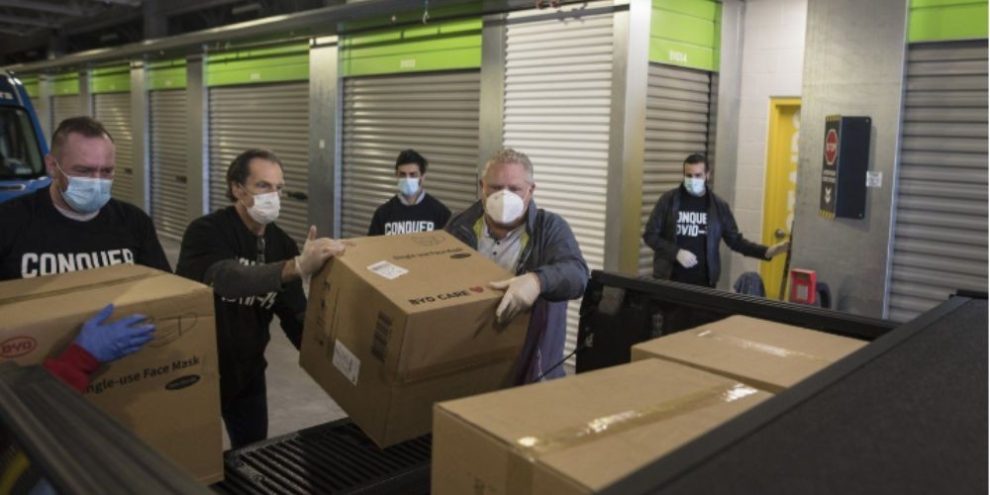
Ontario wrote off more than one billion items of personal protective equipment at a cost of $1.4 billion since 2021, the province's auditor general found.
Shelley Spence found the province continues to purchase masks, gowns and other protective gear at the same levels as the height of the COVID-19 pandemic in 2020 and 2021, despite significantly declining demand.
"We found that expired products began to accumulate in the provincial stockpile as some of the products purchased during the pandemic fell short of desired quality standards and were not used," Spence wrote in her annual report.
Ontario had a critical shortage of protective gear during the pandemic, especially in the early days when much of the province's inventory of PPE had already expired.
The province created Supply Ontario in late 2020 to manage the stockpile but Spence found it does not have a system that can properly track the gear.
"Supply Ontario does not have an effective inventory management system in place to report costs on a timely basis and instead relies on inefficient manual process to report yearly," Spence wrote.
Supply Ontario now incinerates expired PPE and converts it to heat energy rather than recycling it like British Columbia does, Spence found.
The province signed long-term contracts for PPE between October 2020 and April 2021 that locked it into buying 188 million surgical masks annually. Yet it only distributed 39 million of those masks last year, or 21 per cent.
The auditor also found Supply Ontario bought 25 million N95 masks in 2024/25, but it distributed only 5.5 million, or 22 per cent.
"Assuming usage levels are unchanged, we estimate that approximately 376 million surgical masks and 96 million N95 masks, worth approximately $126 million of taxpayers' money, will expire between 2025/26 and 2030/31," Spence wrote.
"If purchase commitments must be maintained to satisfy the policies of protecting public health and supporting local production, and Supply Ontario does not increase its distribution of PPE, waste will likely continue to occur."
Despite the vast amount of PPE stockpiled, Spence found only a "disproportionately low" two per cent of the items go to hospitals, which say the province cannot meet their needs.
Spence recommended Supply Ontario create a system to integrate and consolidate inventory records from a variety of sources and to better use that data to mange and report on PPE levels. She also recommended the province conduct a value-for-money analysis to make better policy decisions on purchasing commitments.
She also suggested the province develop and implement a plan to increase usage of PPE, particularly to hospitals.
Supply Ontario has agreed with all six of Spence's recommendations.
This report by The Canadian Press was first published Dec. 2, 2025.