
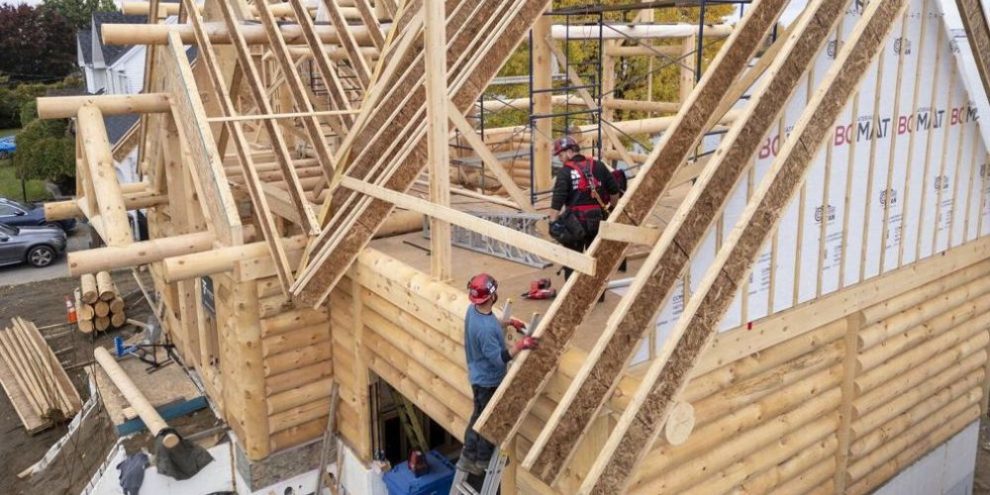
Housing starts in Canada rose 5.6 per cent in 2025, boosted by new rental housing construction, but the figure was still far short of what the Canada Mortgage and Housing Corp. says is needed to make housing more affordable.
Mathieu Laberge, CMHC's chief economist and senior vice-president of housing insights for the agency, says any additional supply is welcome, but that the year-over-year increase in 2025 was "far from the target."
The national housing agency said Friday that housing starts totalled 259,028 last year, up from 245,367 a year earlier.
Barrie's News Delivered To Your Inbox
By submitting this form, you are consenting to receive marketing emails from: Central Ontario Broadcasting, 431 Huronia Rd, Barrie, Ontario, CA, https://www.cobroadcasting.com. You can revoke your consent to receive emails at any time by using the SafeUnsubscribe® link, found at the bottom of every email. Emails are serviced by Constant Contact
The increase came as Canada’s six largest markets recorded a combined 3.9 per cent year-over-year increase from 2024, driven by record annual starts in Calgary and Edmonton, a 58 per cent year-over-year increase in annual starts in Montreal, and a 12 per cent increase in Ottawa-Gatineau.
Those results outweighed year-over-year decreases in Toronto and Vancouver. The former saw housing starts drop 31 per cent while the latter fell three per cent year-over-year.
Last June, CMHC released new projections which said up to 4.8 million new homes would need to be built over the next decade to restore affordability levels last seen in 2019, based on projected demand.
That would mean between 430,000 and 480,000 new housing units are needed per year across the ownership and rental markets by 2035.
"It will take time. This is a long-term process to get to the point where we can see that," Laberge said in an interview.
"It's a milestone in getting to the right point, but we're not there yet."
Laberge said momentum for building new housing supply in 2025 peaked in spring and early summer, before dipping later in the year.
He said increases were driven in part by a second consecutive year of record rental housing starts, which made up just over half of all housing starts in Canada’s urban centres.
Laberge also highlighted a pivot by developers to "missing middle" housing. In the face of economic uncertainty driven by Canada's trade war with the U.S., he said many were reluctant to kick off large condo projects.
Instead, they turned their attention to developments that were cheaper to build. That included ground-oriented, mid-density projects such as row-style homes, plexes, townhouses and secondary suites.
"In an uncertain environment, developers would rather go small and fast, than big and slow," Laberge said. "I think it's really what sustained the market."
The overall seasonally adjusted annual rate of starts in December amounted to 282,439 units, up 11 per cent from 254,625 in November, while the annual pace of rural starts was estimated at 12,271 units in December.
Actual housing starts in December in centres with a population of 10,000 or greater totalled 20,716 units, up 25 per cent from 16,531 units in December 2024.
The six-month moving average of the seasonally adjusted annual rate of total housing starts in Canada ticked 0.1 per cent lower to 264,428 units in December from 264,716 in November.
"December's firm gain left starts highly elevated when compared to historical trends and likely reflects momentum in purpose-built rental construction," TD economist Rishi Sondhi wrote in a note.
But Sondhi said starts were still about six per cent lower quarter-over-quarter in the final three months of the year.
"December's gain was also concentrated in Ontario, where construction costs are elevated and pre-sales activity continues to be weak, meaning last month's gain is likely unsustainable," he said.
"Moving forward, we think that Canadian housing starts will moderate this year due to sharply slower population growth, rising vacancy rates across several regions, climbing unsold inventories, and weak pre-construction sales activity in the GTA market."
This report by The Canadian Press was first published Jan. 16, 2026.