Updated March 26, 2026 @ 6:42pm
Iran and the United States appeared at an impasse Thursday, hardening their positions over ceasefire talks and setting the stage for another potential escalation in the Middle East war as thousands more U.S. troops neared the region.
Meanwhile, President Donald Trump extended his deadline for Iran to open the Strait of Hormuz to April 6, and Tehran tightened its grip on the crucial strait while Israel poured more troops into southern Lebanon to fight the Iran-backed militant group Hezbollah.
Sirens over Israel warned of barrages of incoming Iranian missiles, and Gulf nations worked to intercept fire. Heavy strikes were reported in Iran’s capital and other cities.
In a war that appears defined by who can take the most pain, the U.S. has offered shifting objectives, including ensuring Iran’s missile and nuclear programs are no longer a threat and ending Tehran’s support for armed groups in the region. Washington at one point also pushed for the overthrow of Iran’s theocracy.
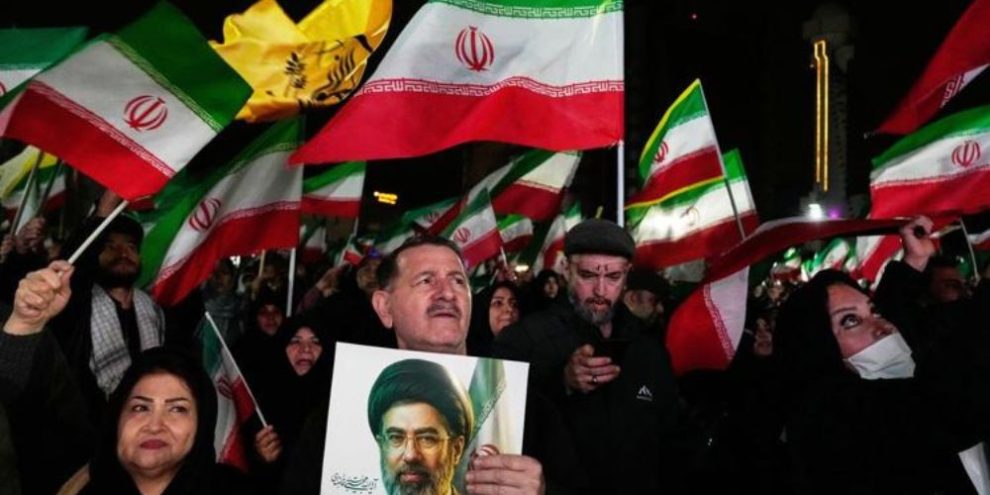
While the U.S.-Israeli campaign has hit Iran’s military and government hard, killing top leaders and striking scores of targets, Iran continues to fire missiles, and there is no sign of an uprising against the government.
Surviving could be seen as victory for Iran
For Iran’s leadership, by contrast, merely outlasting the onslaught could be seen as victory. It may be hoping to get the U.S. to back down by roiling the world economy with its stranglehold on the the strait, which has disrupted oil and natural gas shipments and raised prices worldwide for energy and other goods.
Short of a negotiated solution, the U.S. would need a dramatic escalation to end Iran’s attacks and restore the free flow of goods through the strait, where 20% of all traded oil and natural gas is transported in peacetime. Iran rejected a ceasefire proposal put forth by the U.S., while putting forth its own demands.
Trump has vowed to strike Iran’s power plants if it does not fully reopen the strait. His new deadline pulls back on his earlier threat to bombing Iran’s energy plants if Tehran did not open the critical waterway.
Iran had threatened to retaliate against the region’s vital infrastructure, like desalination facilities, if Trump followed through. Trump said he was holding off on carrying out his threat because talks aimed at ending the conflict are going “very well.”
A Gulf Arab bloc said Thursday that Iran is now exacting tolls from ships to ensure their safe passage through the waterway.
Iran seen as operating Strait of Hormuz as ‘de facto toll booth’
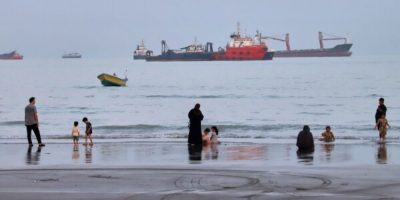
Iran has been blocking ships from the strait that it perceives as linked to the U.S. and Israeli war effort, while letting through a trickle of others. Trump said during a Cabinet meeting Thursday that Iran is allowing some oil tankers through as a sign of good faith for talks.
Jasem Mohamed al-Budaiwi, secretary-general of the Gulf Cooperation Council, a bloc of six Gulf Arab nations, said Iran was charging for safe passage.
Lloyd’s List Intelligence called it a “de facto ‘toll booth’ regime,” saying that at least two vessels have paid in yuan, China's currency.
Iran’s grip on the strait and relentless attacks on Gulf energy infrastructure have sent Brent crude, the international standard, up more than 40% since the war started.
Israel said it killed the head of the Iranian Revolutionary Guard’s navy, Commodore Alireza Tangsiri, and the country’s naval intelligence chief, Behnam Rezaei. Israeli Defense Minister Israel Katz said Tangsiri was responsible for bombing operations that have blocked ships from crossing the Strait of Hormuz. Iran did not immediately acknowledge the killings.
Trump says Iran needs to ‘get serious’ about negotiations
Using Pakistan as an intermediary, Washington has delivered to Iran a 15-point “action list,” Trump envoy Steve Witkoff confirmed Thursday, calling it a framework for a possible peace deal. Witkoff said there were “strong signs” the U.S. could “convince Iran that this is the inflection point, with no good alternatives for them other than more death and destruction.”
Barrie's News Delivered To Your Inbox
By submitting this form, you are consenting to receive marketing emails from: Central Ontario Broadcasting, 431 Huronia Rd, Barrie, Ontario, CA, https://www.cobroadcasting.com. You can revoke your consent to receive emails at any time by using the SafeUnsubscribe® link, found at the bottom of every email. Emails are serviced by Constant Contact
A day after saying Iran wants to cut a deal, Trump posted on social media Thursday that Tehran needs to “get serious soon” on negotiating an end to the war “before it is too late.”
Press TV, the English-language broadcaster on Iranian state television, said Iran has its own five-point proposal, which includes reparations and recognition of its sovereignty over the Strait of Hormuz.
But Iran’s Foreign Minister Abbas Araghchi said in an interview on state TV that his government has not engaged in talks to end the war and does not plan to. He said the U.S. had tried to send messages to Iran through other nations, “but that is not a conversation nor a negotiation.”
Egypt is also acting as a go-between, according to Egyptian Foreign Minister Badr Abdelatty, who said Thursday that his country sees a desire from both sides “for calm, for the exploration of negotiations.”
As the diplomatic efforts went on, a group of ships, including the USS Tripoli, drew closer to the Mideast with some 2,500 Marines. Also, at least 1,000 paratroopers from the 82nd Airborne — trained to land in hostile territory to secure key territory and airfields — have been ordered to the region.
Ali Bahreini, Iran's top envoy to U.N. institutions in Geneva, warned Thursday that any U.S. and Israeli attempt to mount a ground invasion of Iran would be a “big” mistake.
A wave of Israeli airstrikes hits as Iran fires on Israel and Gulf neighbours
The Israeli army said Thursday it had deployed the 162nd Division into southern Lebanon, joining thousands of troops that already have moved there since the war erupted. Israel says the open-ended invasion is aimed at protecting its northern border towns from Hezbollah attacks and uprooting the militant group from the area.
Israel also said it carried out a wave of attacks targeting Iranian infrastructure early Thursday. Heavy strikes were also reported around Isfahan, home to a major Iranian air base and other military sites, as well as one of Iran's nuclear sites.
Witnesses told The Associated Press that power is out in some areas of Iran’s capital Tehran, though no official reports have been released yet. Witnesses had earlier reported the sounds of heavy strikes and fighter jets overhead.
Loud booms could be heard across Israel as it was repeatedly targeted by barrages from Iran. Israel’s emergency service said a man in his 30s was killed near the northern coastal city of Nahariya after a wave of strikes that came from Lebanon. In the United Arab Emirates, two people were reported killed by shrapnel from a missile interception over Abu Dhabi.
Israeli military spokesperson Brig. Gen. Effie Defrin said Thursday that the army needs another 15,000 soldiers, roughly half of them combat troops, to be at full strength for its multiple missions. Israel can call up tens of thousands of reservists, but repeated deployments have drawn pushback, with many citing exhaustion and financial strain.
Since the war began, more than 1,900 people have been killed in Iran, Deputy Health Minister Ali Jafarian told Al Jazeera.
Eighteen people have died in Israel, while three Israeli soldiers have also been killed in Lebanon. At least 13 American troops have been killed. More than a dozen civilians in the occupied West Bank and Gulf Arab states have also died.
Authorities said more than 1,100 people have died in Lebanon, where Israel has targeted the Iran-backed Hezbollah militant group, which has fired into Israel. In Iraq, where Iranian-supported militant groups have entered the conflict, 80 members of the security forces have been killed.
___
This story has been updated to correct the death toll in Israel, and that a Trump envoy says there are strong signs Iran can be persuaded it has no option but a deal.
___
Rising reported from Bangkok. Associated Press writers Julia Frankel, Koral Saeed and Sam Metz in Jerusalem, Rod McGuirk in Melbourne, Australia, Jamey Keaten in Geneva and Giovanna Dell'Orto in Miami contributed to this report.