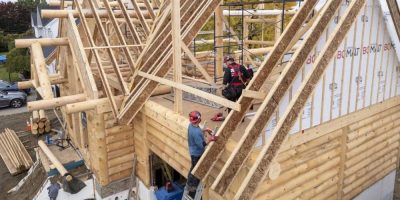

The federal housing minister says he wants to ramp up the lagging pace of homebuilding in some provinces by bringing developers off the sidelines and into Ottawa's affordable housing projects.
Gregor Robertson also said in an interview that the feds' new Build Canada Homes agency is working on getting Canadian banks and pension funds to play an active role in financing affordable homes.
Robertson sat down with The Canadian Press recently as MPs returned to the House of Commons and Prime Minister Mark Carney rolled out the Liberals' latest affordability policy — a top-up to the GST credit pitched as a way to help Canadians cope with the rising cost of groceries and other essentials.
Barrie's News Delivered To Your Inbox
By submitting this form, you are consenting to receive marketing emails from: Central Ontario Broadcasting, 431 Huronia Rd, Barrie, Ontario, CA, https://www.cobroadcasting.com. You can revoke your consent to receive emails at any time by using the SafeUnsubscribe® link, found at the bottom of every email. Emails are serviced by Constant Contact
Robertson, a first-time MP turned cabinet minister and the former mayor of Vancouver, acknowledged that housing has long been a pain point for households struggling to make ends meet.
Nine months into his mandate, Robertson said he is focusing his efforts on the lowest rungs of the housing ladder, where people are most vulnerable.
"I'm very focused on delivering affordable housing as a critical piece for improving affordability in Canada," he said.
Build Canada Homes launched in September with an initial $13 billion capitalization. The agency was tasked with scaling up affordable or "non-market" housing and carries much of the burden of a Liberal promise to double the pace of home construction.
The term "non-market" indicates projects that typically have support from government or other sources, allowing units to be rented out below market rates.
While most Canadians won't live in non-market housing, Robertson said mixed developments — with some affordable units and others offered at market rents — can help to stimulate more activity across the price scale.
One of the first Build Canada Homes projects announced, the 540-unit Arbo development in Toronto, will be at least 40 per cent affordable housing when complete.
The Liberals have been trying for years to stimulate homebuilding in Canada, in part by offering funding directly to municipalities to change zoning and lower other barriers to construction.
The Canada Mortgage and Housing Corp. reported housing starts were up 5.6 per cent across the country in 2025. The single-digit gain was driven by a flurry of building in Alberta and Quebec, while Ontario and British Columbia saw outright declines.
CMHC said momentum in new homebuilding was strong in the spring and summer but stalled in the fall.
Robertson acknowledged the mixed results across the country during his first few months in the housing portfolio.
He also acknowledged that, in order to meet the Liberals' lofty homebuilding targets, the bulk of the construction will have to be led by the private sector.
The pace of that private sector construction is dictated by market conditions — interest rates, material prices, homebuyer demand — that are largely outside the government's control.
But Robertson said Ottawa will look to smooth out the valleys in the market by "crowding" investment from the federal government, the provinces and other partners into affordable housing.
The pitch, as he put it, is that when developers don't see a business case for a new project in the market, Build Canada Homes can step in to make a proposal for affordable housing more attractive.
That would, in theory, put some of Canada's builders to work in a public-supported housing capacity until market conditions improve for private-led developments.
"Certainly in markets where the market is slow, we have a big opportunity to redeploy all the talents of industry to building affordable and make best use of this opportunity, which is long overdue," Robertson said.
"We want to see a win-win here for the economy and for affordable housing."
Mike Moffatt, housing policy expert and founding director of the Missing Middle Institute, said it makes sense for Ottawa to step in "to try and smooth out the natural housing cycles."
He said the trick will be in the timing. If the government fails to move quickly enough to get new homes approved and construction underway, projects might only ramp up when the market is getting hot again — effectively missing a window to boost the affordable supply in Canada.
Scaling up efforts on the non-market side during a lull in construction can also be politically precarious if output then drops off when builders are busy again, Moffatt said.
"People kind of point out, 'Well, you were doing 10,000 homes three years ago, and now you're only doing 2,000 homes, what's going on here?'" he said.
"Theoretically, I think it makes a great deal of sense. The challenge is both in the implementation and some of the politics involved."
Robertson said Build Canada Homes has a more "nimble" approach than previous government programs.
The agency has received 450 applications so far from a mix of proponents, the minister said. Some are led by the provinces, some are for community housing proposals and some are led by private sector developers.
Robertson said his quest to fill the affordable housing gap won't necessarily mean Ottawa is bankrolling those efforts alone.
He specifically mentioned Canadian banks and the country's pension funds as pools of capital he'd like to see deployed for affordable housing.
"My hope is that we can attract capital by dramatically reducing the risk with affordable housing projects," he said. "The federal government, in partnership with other levels and investors, can de-risk affordable housing and make it a long-term stable investment for Canadian capital."
Robertson suggested that Build Canada Homes CEO Ana Bailao, former deputy mayor of Toronto, has been working on attracting new sources of capital to Ottawa's affordable housing strategy and said to "stay tuned."
Moffatt said it's not clear to him what tax breaks or other mechanisms the federal government could use to convince big financial institutions to invest in affordable housing.
By its nature, affordable or social housing tends to be non-profit, Moffatt noted. But pension funds and banks have a duty to their beneficiaries and shareholders to maximize profit.
"Providing very low-income housing to low-income families is a great thing to do, but by its very nature, it doesn't doesn't generate a lot of profit," Moffatt said.
"I think that's the missing ingredient here … It's not clear to me how they're going to pull this off."
This report by The Canadian Press was first published Feb. 1, 2026.