

This Barrie 360 article is brought to you by The Barrie Police Service.
You don’t have to be careless, elderly, or “bad with technology” to fall for a scam. Fraud works because it targets emotions, not intelligence. Fear, urgency, trust, and the pressure to act quickly are what scammers rely on, and those feelings can affect anyone.
Barrie Police say they're seeing a steady rise in sophisticated frauds, especially cryptocurrency scams and fake bank investigator scams. These aren’t random, sloppy attempts. They’re carefully designed to sound legitimate, convincing, and urgent.
The most important thing to know is this: scams are crimes of opportunity. Fraudsters wait for the right moment, when you’re distracted, worried, busy, or emotionally vulnerable.
Cryptocurrency Scams | Bank Investigator Scams | Grandparent Scams | Employment Scams | Romance Scams | Signs of Scams | How to Protect Yourself
The true cost of fraud in Barrie
Fraud is not a small or isolated issue. In the City of Barrie alone, reported fraud losses totaled approximately $17 million last year.
And that number likely only shows part of the picture.
Police estimate that only 5 to 10 percent of frauds are ever reported. Many people feel embarrassed, assume nothing can be done, or do not realize they have been scammed until much later. As a result, the real financial impact is likely far higher.
These numbers underline an important point: fraud is widespread, and silence only helps scammers continue.
The fraud scams police are seeing most right now
According to Kris Nicholson of the Barrie Police Service, two types of fraud are showing up again and again.
Cryptocurrency-based scams
Cryptocurrency is increasingly being used as a tool to carry out fraud. Scammers promote fake investment opportunities, often using well-known names, logos, or public figures to appear credible. Victims may see online ads, videos, or messages claiming that someone famous has made millions using a specific crypto platform.
In some cases, the scam looks very polished. You may even see what appears to be real returns at first.
But the investment dashboard is fake. The money is not growing.
When you try to withdraw it, you’re told you must pay taxes, fees, or clearance costs first. Each payment leads to another demand, and the losses can quickly grow into the hundreds of thousands of dollars.
Bank investigator scams
Bank investigator scams are one of the fastest-growing frauds in Canada.
It often starts with a phone call from someone claiming to be a bank manager or fraud investigator. If they mention a bank you actually use, your attention is immediately locked in.
You’re told your cards have been compromised and that large transactions have already occurred or are about to post.
The scammer keeps you on the phone, calmly walking you through what feels like a legitimate investigation. They may say the transactions haven’t appeared in your account yet and that they’re trying to protect your money.
You’re then asked to:
- Cut up your debit or credit cards
- Write down your PIN numbers
- Place everything in an envelope
- Hand it to a courier sent to your home
The courier is real. Often it’s an Uber or logistics driver who has no idea what they’re delivering.
Your cards are delivered straight to the fraudsters, who can still piece them together and use them quickly at ATMs or for online purchases.
By the time victims realize what has happened, the money is gone.
Other common scams to watch for
While cryptocurrency and bank investigator scams are driving many current cases, Barrie Police also warn about several other scams that continue to impact residents every year. These frauds often resurface in new forms and target people at vulnerable moments.
Grandparent scams
Grandparent scams prey on fear and love. Victims receive a call claiming their grandchild has been arrested, injured, or is in immediate trouble. The caller pressures them to act fast and insists they not tell anyone else.
Payment is often requested in cash, gift cards, or cryptocurrency, with instructions to send money by courier or wire transfer. The urgency is deliberate. Scammers do not want you to pause or verify the story with family.
A simple phone call to the child’s parents can stop this scam instantly.
Employment scams
Employment scams often target job seekers, including students and newcomers. Victims are offered a job quickly, sometimes without an interview, and then told they must pay upfront for equipment, training, software, or uniforms.
Legitimate employers don’t require payment before you start working. If you’re being asked to send money in order to earn money, it’s a strong warning sign.
Romance scams
Romance scams build slowly. Fraudsters form emotional relationships online through dating apps or social media, gaining trust over weeks or months. Once that trust is established, a financial “emergency” appears.
Requests may involve cryptocurrency, wire transfers, or gift cards. The stories vary, but the outcome is the same: money is sent and the person disappears.
If someone you have never met in person asks you for money, it’s almost always a scam.
Fraud can happen to anyone
“The elderly seem to be the most vulnerable in all of this because they are viewed as financially established or afraid,” Kris shares. He goes on to explain that this is especially true of scams like the grandparents scam. “They want to do what they think is right and they wind up losing a lot.”
But the Barrie Police also share that older adults and people who are “not careful” aren’t the only targets. Fraudsters are skilled at creating believable stories and directing your attention away from obvious red flags. They rely on fear, urgency, and the desire to fix a problem fast.
As Nicholson explains, scammers are very good at finding the “perfect storm,” the moment when someone is stressed, worried about money, or afraid of losing something important. This may be asking for duty fees in December when people are waiting desperately for their packages or CRA scams in March and April when people are waiting for their tax returns to pay bills.
It’s in these moments that logic takes a back seat.
Common signs something is a scam
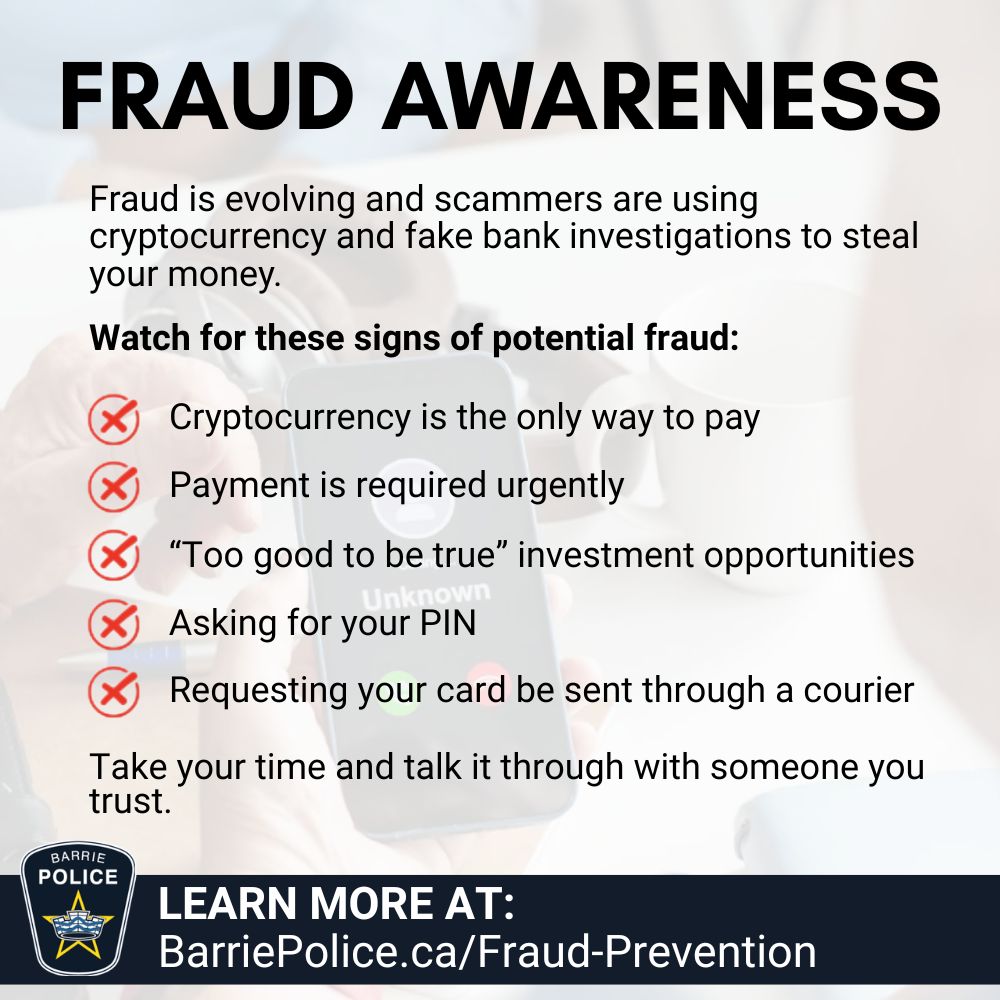
While scams are always evolving, many share the same warning signs. Be especially cautious if you notice any of the following:
- Cryptocurrency is the only way to pay
- You are told payment is required urgently
- An investment sounds too good to be true
- You are asked for your PIN number
- You are asked to send your bank card through a courier
These are major red flags. Legitimate businesses and banks do not operate this way.
How to protect yourself if you’re contacted
If you receive a call, email, or message claiming to be from your bank, a company, or the police, slow things down.
Use these steps instead:
- Hang up and call the phone number on the back of your card
- Visit your local bank branch in person
- Look up the organization yourself and contact them directly
Legitimate institutions will encourage this. They want you to verify who you’re speaking with.
“Take 5, Tell 2”
Barrie Police use a simple phrase that can stop many scams before damage is done.
Take 5 minutes.
Tell 2 people.
Give yourself time for your emotions to settle. Fear and urgency are powerful, and scammers rely on you acting immediately. Then tell two people you trust what is happening. A spouse, friend, or family member who is not emotionally involved can often spot what feels off right away.
If it does not make sense when you say it out loud, it probably isn’t legitimate.
What your bank and police will never ask you to do
This is one of the most important things to remember.
Your bank will never:
- Ask for your PIN number
- Ask you to send your debit or credit card to them
- Ask for your help conducting an investigation
Police will never:
- Demand payment
- Threaten arrest over the phone
- Ask for money, gift cards, cryptocurrency, or valuables
If someone claims to be from your bank or the police and asks for any of these things, it is a scam.
Staying one step ahead of fraud
Fraud is not going away, but awareness is one of the strongest tools you have.
Staying cautious, questioning urgency, and slowing down decisions can make the difference between protecting yourself and becoming a victim.
If you want more information or fraud prevention resources, visit the Barrie Police website or follow their social media channels. Their fraud unit also offers community presentations for local groups, businesses, and organizations.
Taking a few extra minutes today can save months or years of stress later.